Coding Molecular Pathology Is a Science
- By Korrin McNabb
- In Coding
- August 1, 2023
- 2 Comments

Avoiding claim denials requires knowing the rules for each procedure type.
Being new to the medical field, I have been relentlessly applying to jobs and going on interviews. One position I interviewed for was in the genetic testing space. Genetic testing isn’t covered in AAPC’s course curriculum, so while prepping for the interview, I decided to conduct my own research. Although I didn’t get the job, here’s what I learned about molecular pathology.
Editor’s note: This article has been reviewed by AAPC’s Coding Advisory Committee for clinical accuracy.
What Is Molecular Pathology?
Molecular pathology involves testing DNA, RNA, and/or protein to learn more about the presence of disease, risk of disease, and potential incompatibility of transplants and grafts. The codes in this section of CPT® are divided into five groups:
- Genomic Sequencing Procedures (GSP)
- Multi-Analyte with Algorithmic Analyses (MAAA)
- Proprietary Laboratory Analyses (PLA)
- Tier 1
- Tier 2
Code by Group
Tier 1 codes are analyte-specific (an analyte is the specimen being analyzed). Tier 2 codes represent procedures for rare diseases and rarely performed testing. GSP is usually accomplished using next generation sequencing (NGS), which is a new technology that requires obtaining less tissue but has more testing power. To use a GSP code, the entire descriptor must be performed. If the code is not completely fulfilled, report the analysis using Tier 1 or Tier 2 codes, or CPT® code 81479 Unlisted molecular pathology procedure. Do not report two GSP codes that include the same gene: Instead, use the primary disorder to choose the most specific code pertaining to that condition.
To code a PLA, first look under Proprietary Laboratory Analyses in the Alphabetic Index of the CPT® code book, where you can locate the test by specialty or disease. Verify the code in Appendix O, where the test performed must match the proprietary name listed in the left column of the table. PLA codes must include all of the following if required for analysis: Cell lysis, nucleic acid stabilization, extraction, digestion, amplification, hybridization, and detection — don’t report these services separately.
Fun fact: PLA codes are not Category I codes, even though they are located in the Category I section, unless they’re accompanied by vertical parallel up-and-down arrows.
MAAA is an analysis method that uses the results of multiple assays and sometimes patient history to compute a risk score. Most MAAA testing is proprietary and coded using the same steps as discussed for PLAs. MAAA codes that are not Category I are four-digit codes followed by the letter M. Do not code the individual assays involved in MAAA codes. They are simply coded as a unit, though the results of the individual assays may be included (not coded.)
- Do not report Tier 1 and Tier 2 codes in addition to PLA codes — follow the hierarchy in Figure 1.
- When billing Tier 2 codes 81403-81408, include details about the specific analyte or gene(s) that was tested.
- Billing 81479 requires naming the specific gene tested (e.g., in block 80 of the UB-04 claim); and the patient’s medical record must support the use of this code.

Parallel vs. Serial Gene Testing
It’s essential to understand the type of testing the lab performed on genes for proper coding. Genes can be tested in parallel or serially: If the lab is testing a group of genes without waiting for each result to dictate the next test, then the genes are assayed in the parallel method. If the lab is waiting for the results of one gene test before performing the next test, then they are using the serial method. Bill the parallel method as a panel; when the serial method is used, bill for each individual gene assay.

This information assumes the assays are performed on the same date of service (DOS). DOS is the date of collection. If the specimen was collected over multiple days, the DOS is the date the collection ended.
The gene variants listed in the CPT® codes are not exclusive. If additional variants of the same gene are tested, they are included in the code — do not report them separately. Further, all analytical steps starting with cell lysis are included in the molecular pathology codes; you should not report cell lysis, nucleic acid stabilization, extraction, digestion, amplification, or detection separately. However, services preceding cell lysis should be reported separately.
Avoid Denials
The following molecular pathology procedures will garner a Medicare denial:
- Testing for a disease or condition in which babies or children would exhibit its symptoms, or a disease that results in early deaths (e.g., testing for Rett Syndrome in someone 65 or over)
- Screening for a disease or the risk of a disease in a patient without signs or symptoms
- Carrier screening (e.g., the patient wants to know if they carry the gene for sickle cell disease)
- Hereditary cancer syndrome screening (e.g., Cowden syndrome or Lynch syndrome)
- Prenatal diagnostic testing (e.g., amniocentesis)
- Testing without diagnosis-specific indications
- Investigational tests that are not part of a clinical trial (According to Capital Blue Cross, investigational genetic testing is testing performed with a lack of evidence that the patient’s health outcome would benefit from the analysis.)
Don’t Forget the Modifier
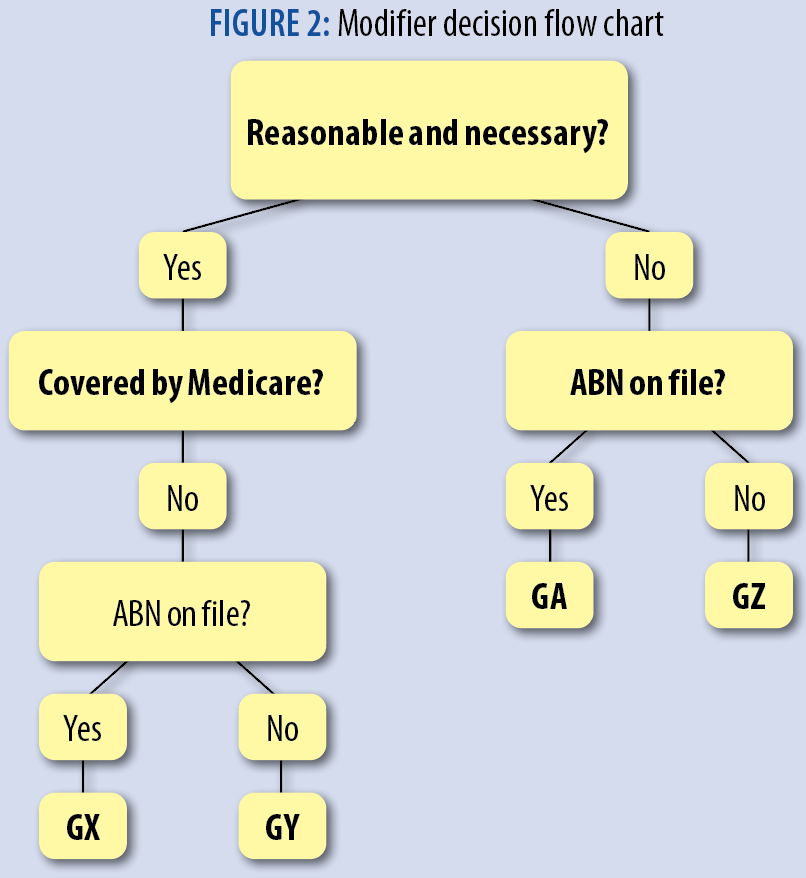
If you’re billing Medicare for a non-covered service, don’t forget the modifier (see Figure 2). Use modifier GY Item or service statutorily excluded, does not meet the definition of any medicare benefit or, for non-medicare insurers, is not a contract benefit when you expect a denial and intend to bill secondary insurance or the patient is liable for payment of the service. Modifiers GX Notice of liability issued, voluntary under payer policy and GA Waiver of liability statement issued as required by payer policy, individual case indicate an Advance Beneficiary Notice (ABN) is on file. Use modifier GZ Item or service expected to be denied as not reasonable and necessary when you’re expecting a denial but the patient is not responsible for payment.
The Results Are In
From this experience, I learned more than just how to code molecular pathology tests. I know now that earning my CPC® is just the beginning of my education. If you have any helpful information to add to this article, I would love to hear it! You can comment on this article online after it is published at www.aapc.com/blog.
Resources:
AACC: Mainstream Clinical Adoption of Multianalyte Assays with Algorithmic Analyses
CMS: Billing and Coding: MolDX: Testing of Multiple Genes
OIG Memorandum Report: Medicare Payments for Part B Claims with G Modifiers,
OEI-02-10-00160
AAFP: Medicare Non-covered Services
ACOG: Prenatal Genetic Diagnostic Tests
CMS: Billing and Coding: Molecular Pathology and Genetic Testing
The Association of Clinical Pathologists: Molecular Pathology
Palmetto GBA: GZ and GY HCPCS Modifier Use

- Coding Molecular Pathology Is a Science - August 1, 2023


chapter 10, section F # 8 states “If one laboratory procedure evaluates multiple genes using a next generation sequencing procedure, the laboratory shall report only one unit of service of one genomic sequencing procedure, molecular multianalyte assay, multianalyte assay with algorithmic analysis, or proprietary laboratory analysis CPT code. If no CPT code accurately describes the procedure performed, the laboratory may report CPT code 81479 (unlisted molecular pathology procedure) with one unit of service or may report multiple individual CPT codes describing the component test results when medically reasonable and necessary. Procedures reported together must be both medically reasonable and necessary (e.g., sequencing of procedures) and ordered by the physician who is treating the beneficiary and using the results in the management of the beneficiary’s specific medical problem.”
Our provider ordered a lab test of JAK2 V617F Cascading reflex to CALR, JAK2 Exon 12, MPL, and CSF3R (NGS procedure). Reporting for this test is done in a stepwise fashion. Once a pathogenic or MPN associated mutation in a target gene is identified the remainder of the genes are not reported or billed. In our patient no identification was done therefore we billed CPT 81270, 81219, 81279, 81339, and 81479. This was denied and the NCCI policy was referenced. But according to this article this is a serial test and we should bill for each gene, is that correct?
Courtney, Please post any question pertaining to specific patient scenarios in our forums or utilize our Ask an Expert service. We are only able to answer questions that pertain directly to the content within the article.