Ask & Learn: Hernia Repair Coding
- By Melissa Kirshner
- In Coding
- November 1, 2023
- 5 Comments

Get questions about CPT® 2023 changes for abdominal hernia repairs answered.
CPT® 2023 added 49591-49596, 49613-49618, and 49621-+49623 for hernia repair services and deleted many of the laparoscopic codes. AAPC’s Documentation Advisory Committee held an Ask & Learn webinar on March 15, 2023, discussing the changes and their effect on coding and billing these services. Here is a recap of that session.
Review the New Codes
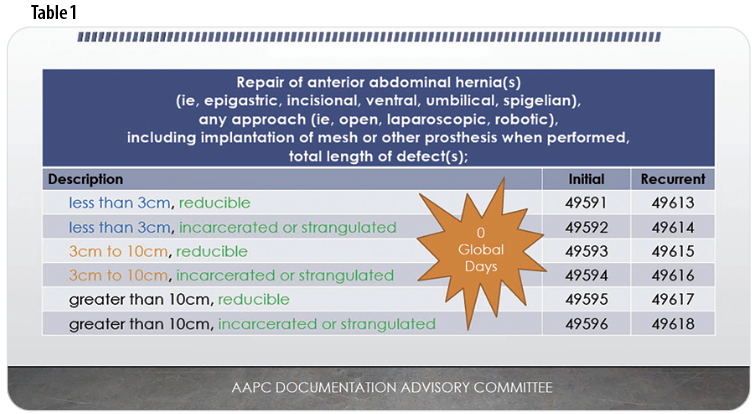
The changes in the Surgery section of CPT® 2023 under Digestive System/Abdomen, Peritoneum, and Omentum/Repair apply to the anterior abdominal hernia repairs, which now include epigastric, incisional, ventral, umbilical and spigelian hernias, repaired by any method or approach (open, laparoscopic, or robotic), regardless of whether the hernia is reducible or not.
These codes include the use of mesh or any other prosthetic material; and for 49591-49596, 49613-49618, code selection is based on the size of the repair(s). As before, size is reflective of the total defect size reported. The physician should take the farthest points of the hernia (top to bottom or side to side) of the defect (not sac) to generate the measurement. If two or more hernias are separated by 10 cm or more of intact fascia, then the physician should measure each hernia separately and add the sizes together. Base your code selection on the total measurement.
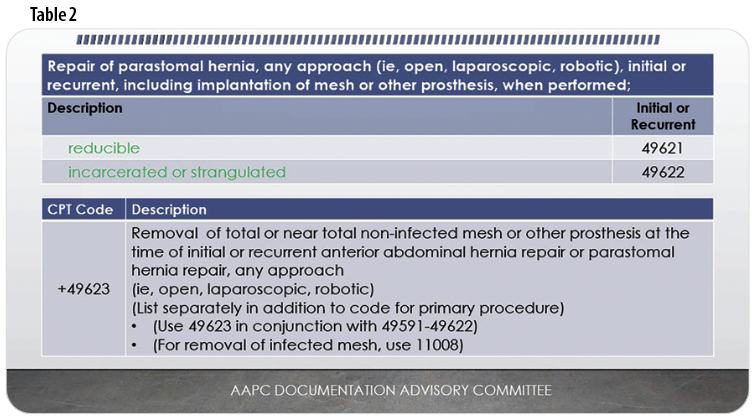
New codes 49621 (reducible) and 49622 (incarcerated or strangulated) are for the repairs of peristomal hernias, initial or recurrent, by any approach. The guidelines state that when repairing both a reducible and an incarcerated or strangulated hernia at the same operative session, measure both together but only report the code that encapsulates the incarcerated or strangulated service. Repairs of other types of hernias (inguinal, femoral, parastomal, etc.), however, can be billed at the same operative session with the applicable codes.
Lastly, add-on code +49623 is for the additional work involved with removal of total or near total non-infected mesh at the time of initial or recurrent repair.
While the global days still exist for other hernia repairs, the abdominal hernia codes now have zero global days. This means that any service done for follow-up post-operatively is separately billable.
The new codes are shown in Tables 1 and 2.
Hernia Coding Q&A
Q: Can the new hernia repair codes be used for patients of all ages?
A: Yes, since there is no age limit defined within the codes or the guidelines, they are applicable to patients of any age who have an abdominal hernia repaired laparoscopically. Only the open surgical repair codes are limited based on age.
Q: If the surgeons repair an abdominal hernia in one area and then make a separate incision in another area to repair a different hernia, can they bill separately for both hernia repairs?
A: Bill the one code if both hernias are in the abdominal area. If they are within 10 cm, measure from the outermost portion of one to the outermost portion of the other, regardless of whether they are connected or not. If they are more than 10 cm apart, measure each one separately and add them together.
It’s important to measure before making the incisions because once the incision is made, the tissue can retract, which will cause the size to change. It’s recommended to include all of the defect size measurements in the operative report. Measuring not only the size of each individual hernia but also the distance between them (the size of intact fascia) is important to support the use of the larger service codes.
Q: What happens when the provider does not give you a measurement or they dictate that it’s “about” 3 cm?
A: Providers will need some education for sure! Your only choice is to code the repair to the lowest size possible. You cannot query in that situation because it is after the fact. A payer representative attending the webinar confirmed that they would not accept an addendum for hernia size. Educating providers on the importance of exact measurements for coding and reimbursement purposes is your best tactic. A tip sheet may be beneficial to help providers with these code changes, particularly for the new size requirement.
Q: Can you code for infected mesh twice if there are infections in two different places?
A: Report +11008 once for the removal of infected mesh. Note, however, that some coders reported denials for using this code with the new hernia repair codes. It’s probable that payers have not updated their system edits. A parenthetical under +49623 in CPT® 2023 clearly states, however, “for removal of infected mesh, use +11008.” Until further guidance is issued, we suggest using this instruction to bolster an argument with the payer for correct payment.
Q: Is S2900 Surgical techniques requiring use of robotic surgical system (list separately in addition to code for primary procedure) still used if robotic approach is included in the code description?
A: Not all payers recognize that code. But because a robotic approach is now included in the hernia repair codes, the use of this code would constitute double billing for services. There may be more clarification issued later since these codes are so new, but for now we do not recommend use of the S2900 code.
Q: What is meant by “incarcerated hernia?”
A: Incarcerated hernias are not reducible. If not repaired, they can become strangulated hernias, which is when blood supply is cut off to the hernia contents (i.e., ischemic).
Q: Since there are no global periods for these new codes, can we use the new suture removal codes now?
A: Yes. You may bill the new codes in addition to the codes for removal of sutures or staples and anesthesia, if required, in addition to an evaluation and management (E/M) service.
Q: With the new zero global days, some people are asking about denials they are getting for a post-op visit using the Z diagnosis code for follow-up after completed treatment, Z09. Anybody else experiencing that?
A: We have not seen or heard any rejections yet. It would make sense for carriers to be kicking them back if they have not updated their systems yet to reflect the zero global days change.
Q: Can all of the hernia repairs be done in an ambulatory surgery center (ASC)?
A: In reviewing the Medicare guidance on these new codes, we do see that the larger codes have a payment indicator of C5 Inpatient surgical procedure – no payment made. This applies to any hernia repair of 3 cm or greater. Only the smallest size hernia repair is payable in an ASC.
Q: Can the hernia codes be submitted with the new G2212 Prolonged office or other outpatient service using a different diagnosis?
A: HCPCS Level II code +G2212 is a prolonged E/M service that may be billed with a highest level E/M service code when billing based on time. You would not report the G2212 with a hernia repair code, but you may be able to use it for the follow-up E/M visit if the time requirements are met. There is a difference in the prolonged service time between Medicare and commercial payers. Commercial payers use E/M code +99417 for prolonged services, and that code can be billed at one minute past the maximum time for the office visit, 55 minutes for an established patient. Medicare does not allow the G2212 code to be used until an additional 15 minutes has elapsed past the maximum time for the E/M service code.
Q: Can implantation of mesh be billed with the repair of an inguinal hernia, and if so, what code is used?
A: The code for implantation of mesh has been deleted, but it was only billable for incisional hernias, historically. To our knowledge, implantation of mesh is included in the inguinal hernia codes.
Q: What about an initial umbilical hernia and a recurrent incisional hernia repaired at the same operative session? How are those reported since they are both in the abdominal anatomic category, with different codes for initial versus recurrent?
A: At the time of the webinar, we did not see any clarification on this. However, an opinion posted by the American College of Surgeons subsequent to the Ask & Learn session states that two different hernia types “would be performed as a single unit with a measurement to include both defects and the bridge of intact fascia.” But this can depend on payer guidance and policy.
Q: If the surgeon performs an open abdominal hernia repair (zero global days) and a laparoscopic inguinal hernia repair (90 global days) and sees the patient for post-operative staple removal from the abdomen, won’t a payer reject the office visit and suture removal as included in the global period?
A: This is where documentation is key. If the payer denies it, then you can appeal with documentation, but the documentation must clearly state that the E/M was for the abdominal hernia repair.
Watch a 2-minute clip of the March 15 Ask & Learn webinar when Melissa Kirshner and fellow AAPC Documentation Advisory Committee members answer a question about coding multiple abdominal hernias.

- Ask & Learn: Hernia Repair Coding - November 1, 2023
- Preventing Cervical Cancer Starts With Awareness - January 1, 2022
- Overcome the Stigma of Social Determinants of Health - July 8, 2019


If hernia mesh is removed due to pain and replaced by new mesh without ventral hernia repair, can we still code hernia repair codes?
This article says no, report 49999: https://www.aapc.com/blog/47611-simplify-hernia-repair-coding/
A patient had abdominal hernia and it repaired. He will okay now. After one year he visited the doctor for femoral hernia. So this femoral hernia is recurrent or initial? The site is different so how would know this initial or recurrent hernia?
Keziah: From the author: A recurrent hernia is one that happens at the site of a hernia that has been previously repaired. If you look at the guidelines preceding the abdominal hernia codes, examples of hernias that are included as “abdominal” are “epigastric, incisional, ventral, umbilical, spigelian.” A femoral hernia is in a completely different area from an abdominal hernia. A femoral hernia occurs in the thigh near the groin. If this is the first time the patient has experienced a femoral hernia, this would be considered initial. Although the patient had a previous hernia repaired, it was in a very different area and would not impact the code selection of the new hernia.
Thanks for the informative recap on CPT® 2023 changes for abdominal hernia repair services. The detailed breakdown of new codes and auditing insights is super helpful, especially with updates on reducible and incarcerated hernias. Great session recap!