The Power and Profitability of Pre-Visit Risk Adjustment Reviews
- By Stephani Scott
- In AAPC News
- July 1, 2024
- Comments Off on The Power and Profitability of Pre-Visit Risk Adjustment Reviews

Establishing a process for risk adjustment coding is a win-win for everyone involved.
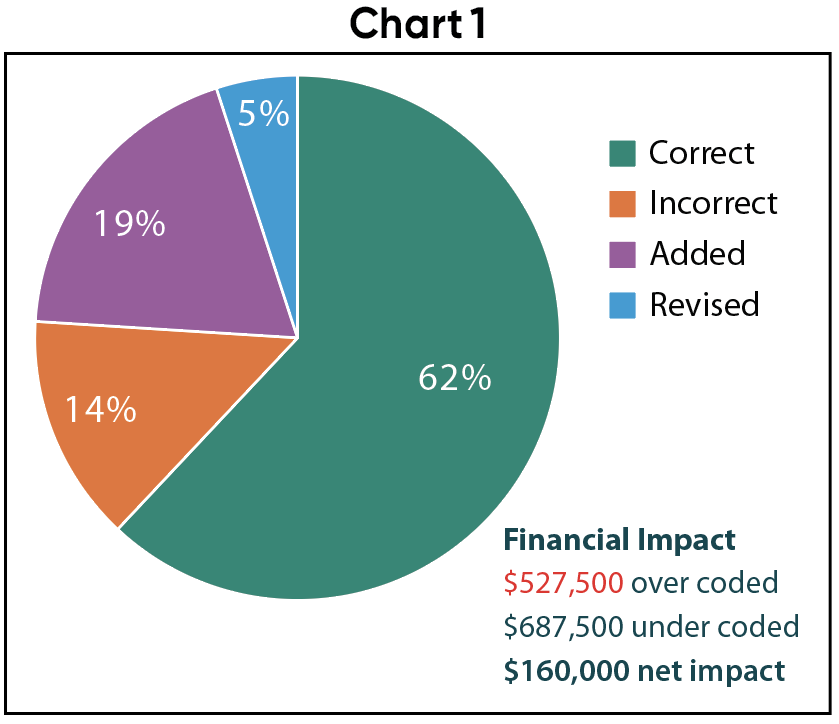
In a 2022 case study, AAPC Services found that most practices were either over- or under-coding diagnoses 14 percent of the time. The over-coding resulted in improper risk adjustment payments of $527,500 and the under-coding resulted in a loss of $687,500. In all, coding errors led to an annual loss of $160,000 in potential risk adjustment payments (see Chart 1). This loss to payers is passed on to the providers.
The problem stems from insufficient documentation, coding errors, and high utilization of unspecified codes. The solution is to perform pre-visit medical record reviews to capture and quantify the reported level of illness or medical complexity in individuals or groups.
Pre-visit risk adjustment reviews are intended to help physicians prepare for upcoming patient encounters. However, they also help to improve distribution of payer funds to practices, align incentives with rewards, and enhance the quality and efficiency of patient care and outcomes.
Clinical Benefits
Pre-visit risk adjustment reviews serve as a proactive means of identifying patients’ potential health risks and issues before scheduled appointments. This measure enables healthcare teams to coordinate services and allocate resources more efficiently for patients with complex or chronic conditions.
By reviewing a patient’s medical records in advance, the multidisciplinary care team can identify individual patient needs, determine if specialists or allied health professionals need to be involved in the visit, arrange for specialized equipment or supplies, and ensure the availability of support staff. Clinicians analyze the patient’s medical history, laboratory results, and other relevant data to identify risk factors, nonadherence to treatment plans, medication interactions, and/or abnormal test results that need to be followed up on.
This proactive approach not only optimizes the visit process but also reduces wait times, lightens the physician’s workload, and enhances patient care.
Financial Benefits
Certified risk coders are essential to the success of the pre-visit review process. A skilled coder can identify and resolve potential issues such as undercoding that do not fully reflect the complexity or severity of the patient’s condition or overcoding that overstates the level before the patient’s upcoming visit.
Example: ICD-10-CM code F32.A Depression, unspecified is reported; however, the documentation is suggestive of more specific code F32.1 Major depressive disorder, single episode, moderate, which maps to HCC 59. Gone undetected, this would result in a coding error, improper risk adjustment, and a host of other problems.
Furthermore, coders can guide physicians toward compliant documentation practices to ensure coding practices align with current coding guidelines, which will reduce claim denials and lower penalties from the Centers for Medicare & Medicaid Services’ Risk Adjustment Data Validation program and other payer audits. By aligning coding practices with current guidelines, coders can safeguard against potential revenue loss and strengthen financial integrity.
The Pre-Visit Review Process
Before implementing pre-visit reviews in your practice, it’s essential to know your target. Knowing your destination will help you gain a better understanding of the steps needed to get where you want to go.
The objective of a pre-visit review is multifaceted. The goals of the risk coder are to:
- Identify patients with likely or suspected HCC conditions;
- Pinpoint diagnoses that may not have been accurately captured;
- Uncover documentation conflicts or incomplete notes;
- Identify missing status updates of conditions; and
- Rectify coding errors.
A thorough review of the patient’s medical history and previous visits to their primary care provider and specialists over 12-18 months is optimal for finding missed HCC opportunities. If a comprehensive review of the entire record within the designated timeframe isn’t feasible due to resource constraints, prioritization becomes imperative. Focusing on specific providers treating conditions associated with the risk adjustment model being used and targeting particular visit types can result in quick wins.
Once the scope is determined, begin by pulling each physician’s patient schedule 1-2 weeks in advance of the appointment. Some organizations prefer the review to take place 2-5 days in advance. It’s essential to strike a balance. Pulling schedules too far in advance is likely to result in overlooking last-minute appointments. Whatever your threshold is, keep in mind that anything beyond 30 days is too far out.
Because coders are not clinicians, they often feel uncomfortable reviewing diagnostic tests for missed coding opportunities. Providing clear directives and comprehensive training empowers coders to effectively utilize their skills in interpreting medical records so that suspected conditions can be identified for the physician to accept or decline.
Coders must spend their time wisely. They should begin the review process with the problem and medication lists for a holistic view of chronic conditions requiring attention during the upcoming visit and then analyze diagnostic tests and laboratory results for changes or indications of new conditions to be added to the problem list. A review of specific visit notes should follow. Consultation notes are excellent to review, as they often unveil new diagnosed conditions.
Physician Queries
Physician queries must be precise regarding what needs to be clarified and why. They should include only the facts and must be compliant with the organization’s guidelines. Clear and concise communication of the coder’s findings regarding suspected HCC conditions, coding errors, and documentation gaps should be conducted efficiently to ensure minimal disruption to physicians and to foster a collaborative atmosphere. Utilizing electronic messaging queues or alert notices or integrating physician queries into the order workflow can facilitate seamless communication.
Physician Responsibility
Physicians have a key responsibly in the pre-visit review process. It’s imperative that they actively contribute to the development of the process, participating in clinical huddles and reviewing coder queries prior to seeing the patient. Additionally, physicians bear the responsibility of addressing all patient conditions, resolving documentation gaps, and completing visit notes in a timely manner.
Overcoming Challenges
The biggest challenge when establishing a pre-visit review process is having staff members with the correct skill set to perform the reviews. Time is another challenge, as are lack of technology to assist in streamlining the process and lack of buy-in from within the organization. To address these challenges:
- Enlist the support of key stakeholders such as your CFO, compliance manager, practice manager and physician champion.
- Invest in training and technology.
- Consider leveraging HCC analytic tools, implementing computer assisted coding, and/or integrating artificial intelligence coding tools.
Demonstrating the financial benefits of these investments is crucial. Present industry case studies highlighting the risks associated with incorrect coding to increase support and conduct a proof of concept by piloting the process with a small group of providers for 30 days, followed by a formal return‑on‑investment summary.
Embracing Change
Implementing a thorough pre-visit review process streamlines office processes, enhances medical record documentation, mitigates denials and compliance risks, ensures coding precision for optimized reimbursement, and empowers physicians and clinical teams to deliver quality care to patients. By embracing pre-visit reviews, your healthcare organization can navigate the complexities of HCC risk adjustment with confidence.
Resources:
Converting Risk Into Revenue: AAPC
The Power and Profitability of Risk Adjustment Reviews: AAPC

- Rise to Your Revenue Potential - September 2, 2025
- Bill G2211 With Confidence (and Modifier 25) - February 3, 2025
- A Case for Coding-Aware AI Scribes - November 1, 2024


