Find Value in Documenting Housing Instability or Inadequacy
- By Alyssa Foster
- In Coding
- December 2, 2024
- Comments Off on Find Value in Documenting Housing Instability or Inadequacy

Medicare puts a price on documenting social determinants of health at inpatient admission.
In the hospital Inpatient Prospective Payment System (IPPS) final rule for fiscal year (FY) 2025, the Centers for Medicare & Medicaid Services (CMS) finalized a policy change that may have big implications for how inpatient hospitals are paid when treating patients with inadequate housing or housing instability. Here’s what you need to know.
Defining Social Determinants of Health
Social determinants of health (SDOH) are “those conditions in which people are born, grow, live, work, and age, as well as the complex, interrelated social structures and economic systems that shape these conditions,” according to the Centers for Disease Control and Protection (CDC).
Inadequate housing is defined by CMS as an occupied housing unit that has moderate or severe physical problems (for example, deficiencies in plumbing, heating, electricity, hallways, and upkeep). Features of substandard housing have long been identified as contributing to the spread of infectious diseases. Individuals living in inadequate housing may be exposed to health and safety risks, such as vermin, mold, water leaks, and inadequate heating or cooling systems.
Housing instability is defined by CMS as individuals with housing challenges that include trouble paying rent, overcrowding, moving frequently, or spending the bulk of household income on housing.
CMS explains in the FY 2025 IPPS final rule that there is an increased body of evidence correlating poor housing conditions with poor health. Some examples provided include increased morbidity from infectious diseases, chronic illnesses, exposure to toxins, injuries, poor nutrition, and higher rates of mental illness. Not surprisingly, patients who experience poor health as a result of inadequate housing or housing instability have higher rates of inpatient admissions for mental, behavioral, and neurodevelopmental disorders, longer hospital stays, and substantial healthcare costs.
What Has Changed?
In recognition of the increased inpatient hospital resource costs for patients who have inadequate housing or housing instability, Medicare finalized changes to the IPPS that resulted in re-designation of the severity level for secondary diagnosis Z codes that describe inadequate housing and housing instability (see Table 1).
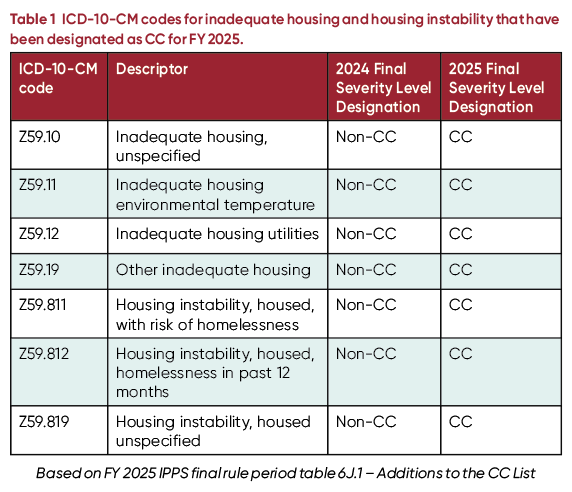
Prior to the change in policy, these ICD-10-CM diagnosis Z codes had a severity designation of non-complication or comorbidity (nonCC). The severity level designation for diagnosis codes is important because a higher severity level designation generally results in a higher payment to the hospital. For example, a severe burn case with documented housing instability may result in assignment to MS-DRG 928 Full thickness burn with skin graft or inhalation injury with CC/MCC with an approximate payment of $47,531. Compare this to a similar case with no documented housing instability that is assigned to MS-DRG 929 Full thickness burn with skin graft or inhalation injury without CC/MCC with an approximate payment of $22,634.
Here’s the Catch
The increased hospital inpatient payment can be significant but can only be received by the hospital if the patient’s medical record demonstrates inadequate housing or housing instability and the coder assigns the applicable secondary ICD-10-CM diagnosis Z code(s).
CMS states in the final rule, “We hope and expect that this finalization will foster the increased documentation and reporting of the diagnosis codes describing social and economic circumstances and continue to serve as an example for providers that when they document and report Z codes, CMS can further examine the claims data and consider future changes to the designation of these codes when reported as a secondary diagnoses.”
Hospitals should be aware of this policy change, which went into effect Oct. 1, 2024. To capture the correct MS-DRG, it will be necessary to implement processes that capture patients’ SDOH, including inadequate housing or housing instability, at the time of admission.
Resources:
FY 2025 IPPS Final Rule Home Page

- Coding Simulation Angiogram for Tumor Radioembolization - October 1, 2025
- CPT® 2025: Skin Cell Suspension Autografts - August 6, 2025
- Find Value in Documenting Housing Instability or Inadequacy - December 2, 2024


