Coding Diabetes Medication
- By Angela Wubben
- In Billing
- January 2, 2025
- 3 Comments

Break down the complexities of billing for these essential supplies.
Diabetes mellitus is a complex disease, so it stands to reason that its diagnosis coding is equally complex. Another aspect of diabetic coding complexity is medications, which is our focus for this article.
Why Is Diabetes Coding So Complex?
First, coders must consider the type of diabetes, the etiology of secondary diabetes, and diabetic complications. Next, coders must look in the physician’s documentation for the status of diabetes: stable, controlled, at goal, progressing, or exacerbated. Further, if documentation states “uncontrolled,” did the clinician specify hyperglycemia or hypoglycemia? If the physician’s documentation of control is not clear, a query may be necessary. Coders must also dissect the documentation for treatment to determine if adding codes for medications or an insulin pump is appropriate, as well as if a continuous glucose monitor was reviewed and interpreted to evaluate treatment effectiveness.
It Helps to Understand the Disease
Diabetes is a chronic condition that impacts the body’s ability to appropriately utilize sugars for energy. When a person consumes food, the digestive system goes to work breaking down the food into basic elements. Carbohydrates, when broken down into their most elemental form, are converted to monosaccharides. Monosaccharides are released into the blood and converted to glucose by the liver. As glucose flows into the bloodstream, signals are sent to the pancreas.
The human pancreas is both an endocrine and exocrine organ. As an exocrine organ, it secretes digestive enzymes into the duodenum to assist with the process of digestion and breaking down food for energy. As an endocrine organ, it responds to the increase in blood glucose to release the hormone insulin into the bloodstream.
Insulin is produced by beta cells, contained within tissue called the Islets of Langerhans, which contributes only 2 percent to the pancreas volume. Insulin acts as a key to open the door for glucose to enter the cell, which can then be used for energy. When there is a dysfunction in the production of insulin or how it functions, the result is diabetes.
Diabetes is diagnosed by the buildup of glucose in the bloodstream, causing hyperglycemia (high blood sugar). Chronic hyperglycemia is responsible for many complications, including cardiovascular disease, nerve damage (neuropathy), kidney damage (nephropathy), eye disease, unintentional weight loss (due to metabolism of fat and muscle, as cells do not have access to glucose to metabolize), and diabetic ketoacidosis. The type of diabetes is identified by the dysfunction causing the hyperglycemia.
Type 1 diabetes — the inability of the beta cells in the pancreas to create insulin — is identified with ICD-10-CM code E10.-. Although type 1 can occur at any age, it often presents in childhood, and therefore is also called juvenile diabetes. People with type 1 diabetes must be given insulin to survive. Without supplemental insulin, the patient has no way to unlock the cells and move glucose out of the bloodstream and into the cells for energy. In the 2025 update, ICD-10-CM introduced E10.A- Type 1 diabetes mellitus, presymptomatic, otherwise known as early-stage type 1 diabetes mellitus. In this phase, there are codes which correspond to the specificity documented as to whether the patient has multiple confirmed islet autoantibodies and normoglycemia (E10.A1), dysglycemia (E10.A2), or unknown (E10.A0).
Type 2 diabetes — the most prevalent type — is identified with ICD-10-CM code E11.-. People with type 2 diabetes have a pancreas which functions and produces insulin but there are often defects in the amount of insulin produced. This is often coupled with reduction of insulin-sensitive tissues to appropriately respond to insulin, which is called “insulin resistance.”
Latent autoimmune diabetes in adults (LADA) is a newly recognized form of diabetes. Patients with LADA have a slowly progressing autoimmune disease which damages the pancreas over time, ultimately resulting in the pancreas failing to produce insulin. In this way, it is similar to both type 1 diabetes (in that the pancreas may not function at all someday) and type 2 diabetes (in that it occurs later in life). LADA is classified as diabetes 1.5 and is coded under category E13.- Other specified diabetes mellitus. People with LADA may be initially classified as having type 2 diabetes because of the age of onset. However, they do not share many of the characteristics of typical type 2 diabetes — many people with LADA are physically active and not overweight, for example. LADA is managed in the same way as type 2 diabetes, initially, but as the pancreas ceases to function, a person with LADA will eventually require insulin replacement, just like someone with type 1 diabetes.
Secondary diabetes is caused by another condition or by drugs or chemicals. Diseases which can cause or induce secondary diabetes include Cushing’s disease, pancreatitis, cystic fibrosis, certain neoplasms, and more. Secondary diabetes caused by another condition is identified with category E08.-. Diabetes can also be induced by certain medications. Several medications have risk of hyperglycemia, which in patients who are already predisposed to diabetes, can cause diabetes. Diabetes does not happen overnight with these medications — it results after long-term use of high doses. These medications include glucocorticoids and certain antipsychotics and antiretrovirals, among others. Secondary diabetes caused by drugs or chemicals is identified by category E09.-.
Coding Insulin Control Medications
There are instructional notes for each type of diabetes (E08-E13) at the category level directing coders to:
Use an additional code to identify control using:
- injectable non-insulin antidiabetic drugs (Z79.85)
- insulin (Z79.4)
- oral antidiabetic drugs (Z79.84)
- oral hypoglycemic drugs (Z79.84)
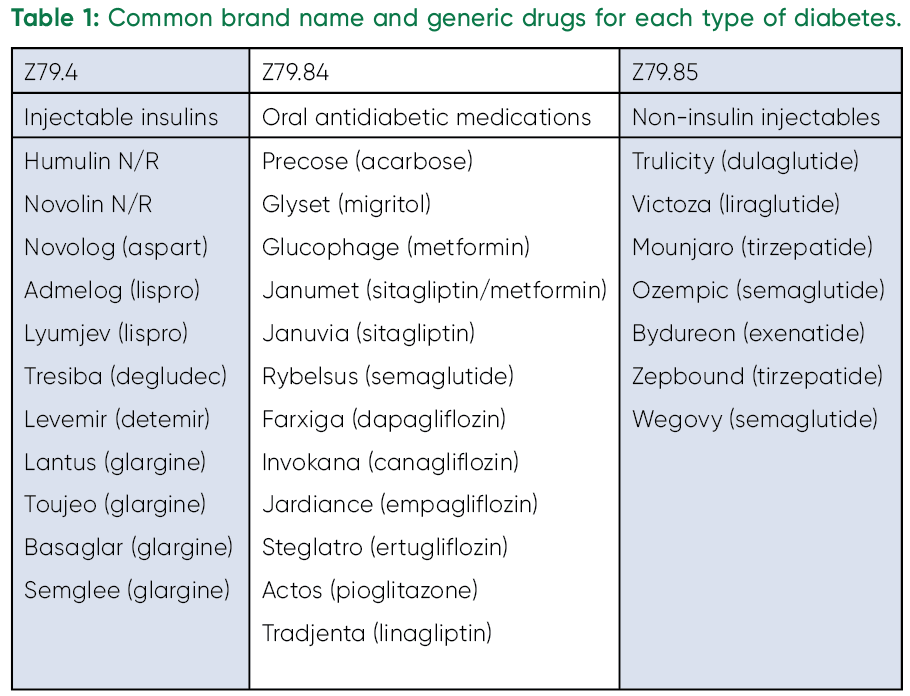
A notable exception to these instructional notes is E10.-: Type 1 diabetes must be treated with insulin, so insulin use is presumed. Other oral and injectable medications used to treat type 2 diabetes have not been proven to be safe and effective for patients with type 1, so their use would be “off label.” There is not an instructional note for E10.- saying as much, but coding long-term use of medications, such as oral or non-insulin injectable medications, may be appropriate when documentation shows they are medically necessary. See Table 1 for common brand name and generic drugs.
ICD-10-CM Guidelines
ICD-10-CM coding guideline I.C.4.a.3 provides instructions related to coding medications used to get diabetes under control and keep it that way. The guideline tells us the following:
If the documentation in a medical record does not indicate the type of diabetes but does indicate that the patient uses insulin, code E11-, Type 2 diabetes mellitus, should be assigned. Additional code(s) should be assigned from category Z79 to identify the long-term (current) use of insulin, oral hypoglycemic drugs, or injectable non-insulin antidiabetic, as follows:
If the patient is treated with both oral hypoglycemic drugs and insulin, both code Z79.4, Long term (current) use of insulin, and code Z79.84, Long term (current) use of oral hypoglycemic drugs, should be assigned.
If the patient is treated with both insulin and an injectable non-insulin antidiabetic drug, assign codes Z79.4, Long term (current) use of insulin, and Z79.85, Long-term (current) use of injectable non-insulin antidiabetic drugs.
If the patient is treated with both oral hypoglycemic drugs and an injectable non-insulin antidiabetic drug, assign codes Z79.84, Long term (current) use of oral hypoglycemic drugs, and Z79.85, Long-term (current) use of injectable non-insulin antidiabetic drugs.
Code Z79.4 should not be assigned if insulin is given temporarily to bring a type 2 patient’s blood sugar under control during an encounter.
The following examples clarify the guideline’s instructions for when and when not to code medications to treat diabetes.
Example 1: A patient with type 2 diabetes is currently stable on his regimen of metformin and Victoza. He has no diabetic complications. Metformin is an oral hypoglycemic medication, and Victoza is a non-insulin injectable medication. Coding is E11.9, Z79.84, Z79.85.
Example 2: A patient has secondary diabetes due to cystic fibrosis. The diabetes is managed with Lantus, Jardiance, and Trulicity. Lantus is a form of insulin; Jardiance is an oral hypoglycemic medication; and Trulicity is a non-insulin antidiabetic injectable medication. Following the ICD-10-CM guidelines and the parenthetical instructions in the Tabular List, coding is E84.9, E08.9, Z79.4, Z79.84, Z79.85.
Example 3: The patient from the first example was admitted to the hospital for a condition unrelated to his diabetes. While in the hospital he was given three doses of insulin to get his blood sugar under control. No changes were made to his usual medication regimen after discharge. In this case, the use of insulin would not be coded because it was only given temporarily.
New for fiscal year 2025: ICD-10-CM instructional notes specify to use an additional code for the patient’s hypoglycemia level with E16.A1, E16.A2, and E16.A3 when the physician documents diabetes “with hypoglycemia.”
Coding Poisoning, Adverse Effects, Underdosing
When coding any medication, including those used to treat diabetes, adverse effects and under- or overdosing often come into the clinical picture. To select the accurate code, go to the Table of Drugs and Chemicals in ICD-10-CM and find the substance in the index (insulin, antidiabetic NEC, etc.). As shown in Figure 1, the base codes are listed on the substance line moving across the intent columns: Poisoning, Accidental; Poisoning, Intentional Self-Harm; Poisoning, Assault; Poisoning, Undetermined; Adverse Effect; or Under-dosing.

These six-digit base codes require a 7th character extension of A Initial encounter (active treatment), D Subsequent encounter (healing or recovery), or S Sequela (complication of original condition and does not identify the sequela itself – coded separately).
Adverse Effects
There is also an instructional note to “Code first, for adverse effects, the nature of the adverse effect, such as: adverse effect NOS (T88.7) ….” Adverse effects of medications to treat diabetes depend on the medication and mechanism of action. Common adverse effects by medication type include:
- Insulin: Hypoglycemia (E08-E13.649), weight gain (R63.5), headache (R51.9), injection site reactions (T88.1)
- Oral: Hypoglycemia (E08-E13.649), diarrhea (R19.7), indigestion (R12), nausea (R11.-), urinary tract infection (N39.0) (some classes)
- Injectable: Appetite suppression (R63.0), early satiety (R68.81), weight loss (R63.4), indigestion, infections, headache, tachycardia (R00.0), injection site reactions
Overdosing
Overdosing of a medication is also called poisoning, and coding depends on intent: For example, T38.3X1 is for accidental (unintentional) poisoning. Codes T38.3X2 and T38.3X3 report intentional overdoses or poisonings; the difference between these two codes is whether the patient self-administered the overdose or someone else administered it. If there is no documentation of intent, assign T38.3X4.
Underdosing
Underdosing of insulin and antidiabetic medications is coded with T38.3X6. An example of underdosing is a patient taking their medication less frequently or at a lower dose than prescribed, which leads to poor control of their diabetes or hyperglycemia. Underdosing can occur for a variety of reasons, such as finances or accessibility, and can be intentional (Z91.120, Z91.128) or unintentional (Z91.130, Z91.138).
Another instructional note for these codes tells us to “Use additional code(s) to specify: manifestations of poisoning; underdosing or failure in dosage during medical and surgical care (Y63.6, Y63.8-Y63.9); underdosing of medication regimen (Z91.12-, Z91.13-).”
Coding Insulin Pump Use
Another consideration when coding insulin is whether the person uses an insulin pump (Z96.41). Insulin pumps are small, wearable devices which inject small, continuous insulin doses (basal insulin) throughout the day, with manual surges (bolus) when eating or to correct high blood sugar. This is similar to how a normally functioning pancreas works. Many people with T1, T2, and secondary diabetes use a pump when insulin is part of their treatment regimen. One downside to insulin pumps is that they can malfunction, causing incorrect dosage. Insulin pump malfunctions are coded with T85.614, which requires a 7th character extender A, D, or S, similar to adverse effects, underdosing, and poisoning.
Take Control
Diabetic medication coding is one element contributing to the overall complexity of diabetic coding. To code diabetic medications accurately, coders must keep several guidelines and instructional notes in mind, as well as remember to code the medication(s) in the correct order, code the presence of an insulin pump when appropriate, and know when and how to code adverse effects, poisoning, or underdosing, including intent. With the wide array of current medications available on the market, it’s wise to become familiar with the most common brand and generic names in both oral and injectable categories.

- Coding Diabetes Medication - January 2, 2025
- Do I Bill Medical or Dental? - April 1, 2022


Hello Angela,
I liked your article very much because you explained very clearly. What about patients who are using non insulin self injectable drugs like Ozempic or Mounjaro and the diagnosis is Obesity/Weight loss. What ICD 10 can I use for this diagnosis? Can you suggest articles so I can read up on this topic. Thank you.
Coding diabetes may be complex but diabetes diagnosis can be well documented if one tries to understand the diagnosis with the causal relationship as indicated in the ICD-10-CM Alphabetic index. The essence of this is to avoid for example; inaccurate patient records that could lead to inappropriate treatment which could eventually lead to high risk complications of the disease. It is imperative to capture the details needed to assign the correct codes and if need be , query the physician or health care providers involved when documentation is not clear.
Angela, we are only able to answer questions that pertain directly to the content within the article. Please post your question in our forums or utilize our Ask an Expert service for further information.