Use Coding Knowledge to Stabilize Cranial Tong/Halo Applications
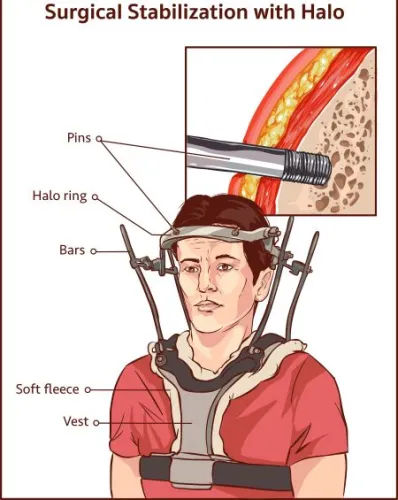
Be sure to count the number of pins the surgeon inserts on cranial halos. Patients who require cranial tong or halo application to stabilize or realign injuries will present challenges if you aren’t familiar with the coding conventions for these procedures. If a patient needs a cranial tong, the coding will differ from a patient who needs a halo. Further, there are different types of halos for different circumstances, which you’ll need to know to report the most accurate codes. Check out this guide on coding for cranial tong/halo applications. Cranial Tongs = Cervical Spine Treatment Cranial tongs are specialized orthopedic and neurosurgical instruments used to realign, immobilize, and stabilize the cervical spine. The surgeon secures the tongs directly into the outer table of the skull via sharp, threaded pins to apply heavy, controlled skeletal traction or to keep the head perfectly still during complex procedures. Examples include Gardner-Wells, Crutchfield, or Mayfield tongs. These tongs are frequently used in emergency and trauma settings to align and stabilize broken neck vertebrae. Cranial tongs may serve any of the following purposes, among others: Know Different Halo Types In neurosurgery, a standard halo is a specialized circular mechanical device attached to the skull with pins to gently pull, straighten, or stabilize the neck and spine. Cranial tongs may serve any of the following purposes, among others: Neurosurgeons use pelvic halos for application of a halo device to the pelvis for skeletal traction. A patient may require a pelvic halo when the surgeon needs substantial skeletal traction through the pelvis to help control or maintain alignment of a severe pelvic/lower-extremity injury when ordinary external supports or skin traction is inadequate. Pelvic halos can treat severe pelvic ring injuries with significant displacement or instability. Pelvic halos might also serve any of the following purposes, among others: Study the CPT® Codes for These Services Here’s a look at the codes you will use for cranial tong/halo application: Both 20661 and 20664 bundle the initial application and the final removal into a single code. The distinction is the number of pins the surgeon places during the procedure. Surgeon Uses These Deciding Factors for Treatment Type A neurosurgeon chooses between a cranial halo and skull tongs based on the treatment goal. Skull tongs are used for temporary, heavyweight bed traction to realign the spine; while the provider uses a cranial halo when the patient needs long-term rigid immobilization or future out-of-bed mobility via a halo vest. The key deciding factors are need for mobility, amount of traction weight, and workflow and transition goals. Skull tongs restrict the patient strictly to bedrest with a weighted pulley system; the patient cannot get up. A cranial halo can transition from bed traction to a body vest, allowing the patient to stand, walk, and leave the hospital. Skull tongs are preferred for high-weight closed reductions (for example, severe cervical dislocations) because two larger heavy-duty pins handle high loads well. A cranial halo spreads the weight across four (or more) smaller pins, making it better suited for lower-weight traction or stable fixation. If the neurosurgeon plans to put the patient in an ambulatory halo vest when spinal alignment is achieved, applying a halo ring from the start avoids a second procedure to switch devices. Kalie Bothma, CPC, CEDC, CSAF, Contributing Writer