Don’t Get Lost in the H. Pylori Testing Maze
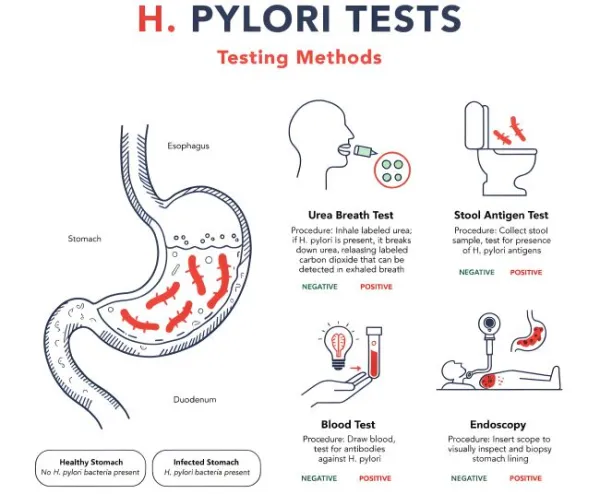
Question: What should I look for in the documentation to determine which code to report for Helicobacter pylori (H. pylori) infection testing? Revenue Cycle Insider Subscriber Answer: H. pylori is a common bacterium that affects the stomach lining, causing stomach pain, peptic ulcers, and sometimes even stomach cancer. The first step in matching the correct code to the test your lab performs requires you to know what was tested. For breath testing, you’ll use one of the folloawing codes: The primary distinction among these codes lies in their functions and whether the isotope used to detect the bacteria is radioactive (C-14) or not (C-13). You’ll use 78267 and 83014 to report the process for collecting the breath sample, while you’ll use 78268 and 83013 to report the analysis portion of the test. For stool testing, you’ll use one of the following codes: For tests involving specimens other than stool, you’ll use the following code: Typically, 87339 involves testing tissue samples taken from a biopsy or from a mucus sample obtained from the gastrointestinal tract during an esophagogastroduodenoscopy (EGD) or an endoscopy. The code represents the lab analysis, not the tissue collection, as that is typically sent to the lab by the provider after administering the procedure. For blood and serum tests, these codes can come into play: These codes report older tests that are not as accurate as other H. pylori tests. As such, they are no longer widely used, and payers such as Aetna and Highmark Blue Cross Blue Shield no longer cover them. So, you would be well advised to check payer policies before reporting 83009 or 86677. Bruce Pegg, BA, MA, CPC, CFPC, Managing Editor, AAPC