• If this is your first visit, be sure to check out the FAQ & read the forum rules. To view all forums, post or create a new thread, you must be an AAPC Member. If you are a member and have already registered for member area and forum access, you can log in by clicking here. If you've forgotten the password it can be reset on our sign in section by entering your registered Email Address or Username here. To start viewing messages, select the forum that you want to visit from the selection below..

Wiki Mild Cognitive Impairment due to Alzheimer's disease

LuckyLily

Guru
Local Chapter Officer
Messages
138
Best answers
0
I'm seeing more providers document Mild Cognitive Impairment due to Alzheimer's disease using G31.84 and G30.9.

However G31.84 would not be appropriate as its, Mild Cognitive Impairment of uncertain or unknown etiology.

Alzheimer's disease requires the secondary code of dementia, following the coding guidelines using the 'see also' and manifestation brackets used in alpha index.

Some coding professionals are then coding this as F06.7x Mild neurocognitive disorder due to known physiological condition. There is a 'code first underlying physiological condition' which would be Alzheimer's disease in this instance. Since dementia is not notated and only states Alzheimer's disease coding professionals are coding it as F06.7x and G30.9 without the dementia code.

The issue: F06.7x has an excludes 1 of dementia, which would then deem F06.7x not valid since Alzheimer's has an additional code requirement of dementia.

How is Mild Cognitive Impairment due to Alzheimer's disease supposed to be coded?
 
G31.84 excludes g30.9. Code F06.7x is a mild neurocognitve disorder due to a known physiological condition such as stroke, brain tumor, ect. This is not used for Alzheimer's disease. Alzheimer's disease is a type of dementia, the secondary code from F02 specifies the dementia. It should be coded according to the documentation, not the supplied ICD 10 codes. If the documentation is unclear, you should query the provider for clarification.
 
F06.7 has Alzheimer's disease (G30.-) listed under the 'code first the underlying physiological condition'.

This is the issue.

If Dementia is to be coded with Alzheimer's disease, as Alzheimer's is a type of dementia, then why is it listed under F06.7 Mild neurocognitive disorder due to known physiological condition. F06.7 has excluded 1 for dementia (F01 F02, F03) and dementia (F02) has an excludes 1 to F06.7 Mild neurocognitive disorder due to known physiological condition
 
I struggled with this exact issue!

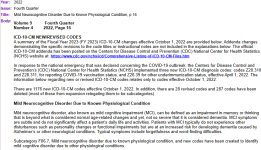
I think the requirement to code also dementia with Alzheimer's changed in 2022 with the introduction of the new mild neurocognitive disorder due to known physiological condition codes. See the coding clinic 2022 Q4 "Mild Neurocognitive Disorder Due to Known Physiological Condition" pg 16.
1779999925808.png
1779999964120.png


After 2022, the coding guidelines at G30 in the tabular changed to use additional code "if applicable" to identify not only dementia but also mild neurocognitive disorder (F06.7-) and the coding "TIP" was removed directing the coder to always assign a code from dementia with G30. (see below).

2026 tabular at G30: 1780000239825.png 2022 tabular at G30: 1780001908747.png

Regarding the Alpha index direction, ICD 10-CM Official Guidelines (Pg 4) for the "see also" instruction indicates another main term may also be referenced. It is not necessary to follow the "see also" note when the original main term provides the necessary code. This is very different than the "code also" instruction. The 2022 alpha index did not have the "see also" instruction at Alzheimer's Disease.

1780000693804.png

ICD10 Official Guidelines pg 3 also indicate that brackets are used in the alphabetic index to identify manifestation codes. If the manifestation (in this case dementia) is not present, it would not be coded.
1780000888804.png

However, it still does not explain why the 2017 Q1 coding clinic is still referenced at G30.9 because, as you mentioned, you cannot code both dementia and Mild neurocognitive disorder. 🤷‍♀️
 
Last edited:
Top