Wiki Breast lumpectomy w/ adjacent tissue transfer

kimberliterpstra

Networker
Messages
39
Location
Kalamazoo, MI
Best answers
0
Surgeon performed a breast lumpectomy with adjacent tissue transfer of 56 sq. cm.
I have always coded 19301 with 14301,58.
However, someone pointed out to me that according to CPT, 14301 is "used for excision (including lesion) and/or repair by adjacent tissue transfer or rearrangement."
My sticking point is the "and/or"... if I apply the "and" portion to my coding scenario, that means I can only code 14301. If I apply the "or" portion to my coding scenario, that means I can code both 19301 and 14301...or does it?
 
The text under the "Adjacent Tissue Transfer or Rearrangement" part of the CPT book, it reads about half way through: "The excision of a benign lesion (11400-11446) or a malignant lesion (11600-11646) is not separately reportable with codes 14000-14302." That doesn't specify 19301 but CPT Assistant does.
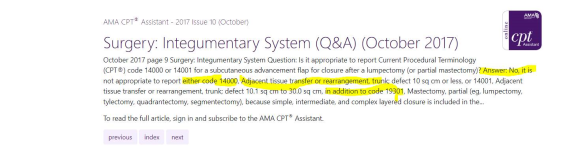
"CPT Assistant October 2017 Surgery: Integumentary System
Question: Is it appropriate to report Current Procedural Terminology (CPT®) code 14000 or 14001 for a subcutaneous advancement flap for closure after a lumpectomy (or partial mastectomy)?
Answer:No, it is not appropriate to report either code 14000, Adjacent tissue transfer or rearrangement, trunk; defect 10 sq cm or less, or 14001, Adjacent tissue transfer or rearrangement, trunk; defect 10.1 sq cm to 30.0 sq cm, in addition to code 19301, Mastectomy, partial (eg, lumpectomy, tylectomy, quadrantectomy, segmentectomy), because simple, intermediate, and complex layered closure is included in the work represented by code 19301."
 
I shared the "CPT Assistant October 2017 Surgery: Integumentary System article with my one of my breast surgeons and he said he agreed a subcutaneous advancement flap shouldn't be billed with 19301. With that being said, he explained to me that they aren't performing a subcutaneous advancement flap, they are making additional incisions to create flaps of tissue that are advanced, rotated to fill the void in the lumpectomy cavity. We discussed that maybe we should bill using CPT 19366.
 
If you have the webinar package, they have one on demand titled Coding Breast Procedures. The last slide discusses this topic and they suggest to bill 14301 in addition to 19301. In order to bill CPT 19366 a graft harvested from a location other than the breast is required. I code for both general & plastics and we've never had an issue with 19301/14301 combination.
 
Last edited:
If you have the webinar package, they have one on demand titled Coding Breast Procedures. The last slide discusses this topic and they suggest to bill 14301 in addition to 19301. In order to bill CPT 19366 a graft harvested from a location other than the breast is required. I code for both general & plastics and we've never had an issue with 19301/14301 combination.
I code these 2 codes together & I get a lot of denials. Even after they are appealed they say the documentation doesn't support the 14001, even though it is clearly documented. Sometimes they say it is included in the 19301. Any suggestions on how you are getting it paid? Thanks.
 
In the practices I code for (Surgical Oncology) my surgeons call it "OncoPlastics closure Techinque" How I would code this, is the 19301-(RT, LT or 50) With the ICD for the path report results (C50.---, Z17.-, D05.--, N60.-- Whatever it may be) and then the 14301-51(it is not bundled and it was not done at a different time of the lumpectomy, with an open wound code. Depending on which breast it was completed on (S21.001A for RT, S21.002A for LT) I have never gotten a denial.
 
I code general, and some of my providers want to bill 14301 with their lumpectomy/mastectomy procedures, however in the CPT book it states ""undermining alone of adjacent tissues to achieve closure, without additional incisions, does not constitute adjacent tissue transfer, see complex repair codes." So if that's what they're documenting, then it's bundled into the excision. The key appears to be to document additional incisions and secondary defects related to the tissue transfer.
 
I code these 2 codes together & I get a lot of denials. Even after they are appealed they say the documentation doesn't support the 14001, even though it is clearly documented. Sometimes they say it is included in the 19301. Any suggestions on how you are getting it paid? Thanks.
Hi which webinar are you referring and can you provide more info please.

thank you
garcia06
 
Have you used modifier 59 with 14001, also I have learned that the measurements has to be included in documentation when using 14001.
 
In my opinion, you would need to have the operative report to determine if a tissue rearrangement can be coded separately that said in my opinion if the definition of 'tissue transfer and rearrangement has been met in the op note, I recommend coding the ATT, as ATT is not simple, intermediate or , complex closure of a surgical incision. The terms being used simple, intermediate and complex closures refer to simple intermediate and complex repairs/closures, not tissue transfers, CMS reference below for the difference.

Oncoplastic reconstruction, to achieve an acceptable cosmetic outcome is integral when the method to achieve this outcome is simple, intermediate or complex repair, i.e. no reconstructive service is performed. Flap transfer, localized tissue rearrangement are not in CPT terms simple, intermediate or complex closures/repairs. If the documentation does not support a tissue transfer: "Tissue transfer and rearrangement requires that adjacent tissue be incised and carried over to close a wound or defect", then the 'complex closure' is integral to the lumpectomy.

References:
CMS: "Extensively undermining of adjacent tissue to achieve closure of a wound or defect may constitute complex repair, not tissue transfer and rearrangement. Tissue transfer and rearrangement requires that adjacent tissue be incised and carried over to close a wound or defect. (NCCI chapter 3 H.3)"

CMS: Closure/repair of a surgical incision is included in the global surgical package. Wound repair CPT codes 12001-13153 (complex wound repair) shall not be reported separately to describe closure of surgical incisions for procedures with global surgery indicators of 000, 010, 090, or MMM

CMS: The CPT Professional classifies repairs (closure) (CPT codes 12001-13160) as simple, intermediate, or complex. If closure cannot be completed by one of these procedures, adjacent tissue transfer or rearrangement (CPT codes 14000-14350) may be used. (NCCI manual CH3 H.1)

NCCI manual CH3 J8 prohibits ATT codes with other reconstructive procedures as the reconstructive procedure include the ATTs related to the same site as the reconstruction: Breast reconstruction procedures (CPT codes 19357-19369) include adjacent tissue transfer, or rearrangement procedures (e.g., CPT codes 14000, 14001) if performed. An adjacent tissue transfer or rearrangement procedure may be reported on the same day as a breast reconstruction procedure if the adjacent tissue transfer or rearrangement is performed at a different site unrelated to the breast reconstruction procedure.
 
Last edited:
In my opinion, you would need to have the operative report to determine if a tissue rearrangement can be coded separately that said in my opinion if the definition of 'tissue transfer and rearrangement has been met in the op note, I recommend coding the ATT, as ATT is not simple, intermediate or , complex closure of a surgical incision. The terms being used simple, intermediate and complex closures refer to simple intermediate and complex repairs/closures, not tissue transfers, CMS reference below for the difference.

Oncoplastic reconstruction, to achieve an acceptable cosmetic outcome is integral when the method to achieve this outcome is simple, intermediate or complex repair, i.e. no reconstructive service is performed. Flap transfer, localized tissue rearrangement are not in CPT terms simple, intermediate or complex closures/repairs. If the documentation does not support a tissue transfer: "Tissue transfer and rearrangement requires that adjacent tissue be incised and carried over to close a wound or defect", then the 'complex closure' is integral to the lumpectomy.

References:
CMS: "Extensively undermining of adjacent tissue to achieve closure of a wound or defect may constitute complex repair, not tissue transfer and rearrangement. Tissue transfer and rearrangement requires that adjacent tissue be incised and carried over to close a wound or defect. (NCCI chapter 3 H.3)"

CMS: Closure/repair of a surgical incision is included in the global surgical package. Wound repair CPT codes 12001-13153 (complex wound repair) shall not be reported separately to describe closure of surgical incisions for procedures with global surgery indicators of 000, 010, 090, or MMM

CMS: The CPT Professional classifies repairs (closure) (CPT codes 12001-13160) as simple, intermediate, or complex. If closure cannot be completed by one of these procedures, adjacent tissue transfer or rearrangement (CPT codes 14000-14350) may be used. (NCCI manual CH3 H.1)

NCCI manual CH3 J8 prohibits ATT codes with other reconstructive procedures as the reconstructive procedure include the ATTs related to the same site as the reconstruction: Breast reconstruction procedures (CPT codes 19357-19369) include adjacent tissue transfer, or rearrangement procedures (e.g., CPT codes 14000, 14001) if performed. An adjacent tissue transfer or rearrangement procedure may be reported on the same day as a breast reconstruction procedure if the adjacent tissue transfer or rearrangement is performed at a different site unrelated to the breast reconstruction procedure.
Thank you, makes more sense.
 
AHA Coding Clinic for CPT® Detail
Article Detail
Volume:2021
Issue:Second Quarter
Title:Goldilocks Reconstruction
Body:Goldilocks Reconstruction
AHA Coding Clinic for HCPCS, Second Quarter 2021, Volume 21, Number 2, Page 10

QUESTION 10

A patient with left breast cancer presented for bilateral skin and nipple sparing mastectomies with Goldilocks reconstruction. After the removal of the breast tissue, dermal autografts/flaps were created and tacked superomedially to create breast mounds. The medial inferior dermal flap was tacked on the pectoralis muscle in the upper inner quadrant and the lateral inferior dermal flap was tacked on the pectoralis in the central portion of the pectoralis muscle. The edges were brought together with staples creating small breast mounds consisting of dermal graft under the mastectomy incision prior to closing the mastectomy flaps. What is the correct code assignment for a mastectomy with Goldilocks reconstruction?

ANSWER
Assign CPT code 19303, Mastectomy, simple, complete, with modifier 50, Bilateral Procedure, for the bilateral mastectomies. Assign CPT code 14000, Adjacent tissue transfer or rearrangement, trunk; defect 10 sq cm or less, or code 14001, Adjacent tissue transfer or rearrangement, trunk; defect 10.1 sq cm to 30.0 sq cm, with the number of units of CPT code 14001 based on the documented square centimeters, for the reconstruction. In a Goldilocks reconstruction, redundant mastectomy flap tissue is utilized to create a breast mound and the technique may be captured with an adjacent tissue transfer code.


Coding advice contained in this issue is effective with procedures/services provided after May 26, 2021, unless otherwise noted.
 
Surgeon performed a breast lumpectomy with adjacent tissue transfer of 56 sq. cm.
I have always coded 19301 with 14301,58.
However, someone pointed out to me that according to CPT, 14301 is "used for excision (including lesion) and/or repair by adjacent tissue transfer or rearrangement."
My sticking point is the "and/or"... if I apply the "and" portion to my coding scenario, that means I can only code 14301. If I apply the "or" portion to my coding scenario, that means I can code both 19301 and 14301...or does it?
in adjacent tissue transfer excision is included,no need to code separately
 
Top