Hey Tara0513, I think the outsourced coding department is correct. Take a look at what I found in the AFP Pathology Service Coding Handbook. It's lengthy but I think you need all the information to fully understand your coding situation.
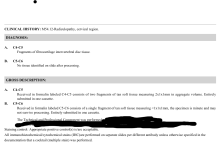
• Specimen Doesn’t Survive Processing. A very small and/or fragile piece of tissue will be macroscopically examined by the responsible pathologist, but the rigors of the subsequent fixation and embedding process may overcome the viability of the material for microscopic examination. In a situation like this, the pathologist should issue a report setting forth a macroscopic diagnosis for the tissue, with a comment documenting the fact that the material didn’t survive processing for microscopic evaluation. A professional and technical fee under CPT 88300 is reportable for the specimen, but the “regular” microscopic exam code (88302- 88309) that would normally have been billed cannot be claimed. For example: − Clinical Example: The gross description for a very small rectal biopsy includes the statement “specimen may not survive processing.” The report confirms that the slide was microscopically examined, but the final diagnosis is “tissue insufficient for diagnosis.” This demonstrates the basis for the coding distinction we must make in a situation like this: a known or reasonably probable negative outcome versus reasonable expectation of a positive outcome. It was known before the rectal tissue was embedded that there was only a 50/50 chance (roughly speaking) that it would support a microscopic diagnosis; hence, code 88300 is reportable for the gross examination, but 88305 for a microscopic examination wouldn’t reflect a medically necessary service. Of course, if the situation were different—if the report didn’t express doubt at the grossing bench as to a viable outcome at the next level of examination—an 88305 charge would be warranted even if the microscopic diagnosis were “scanty mucosal cells present; insufficient for differential diagnosis.” A macroscopic exam is integral to and precedes every microscopic tissue examination, so you can’t report code 88300 together with an 88302-88309 code for the same specimen. But if one specimen for a case is examined gross-only and another is microscopically examined, it’s proper to then report the 88300 code along with the applicable microscopic code (88302-88309). Also, although it doesn’t happen often, you might get two separate specimens examined gross[1]only with a case, and in that instance, it’s proper to report 88300 x 2 for the work; in other words, the unit of service for code 88300 is “each specimen,” just as it is for tissue examined microscopically (see chapter 4 for details). A resident or pathology assistant may perform a gross-only specimen exam, and the question often comes up whether it’s appropriate for the supervising or other responsible pathologist to bill a professional fee for the specimen using code 88300 in that instance. Conventional wisdom holds that it’s proper for the pathology group to bill an 88300 professional fee, provided the pathologist who’s responsible for the grossing room on any particular day walks through once or twice and compares each physical gross-only specimen to the accession log entry to verify that the two reasonably match and that no obvious anomaly is seen. Sometimes a specimen planned for macroscopic examination alone (e.g., kidney stone, tooth, orthopedic hardware, surgical mesh, breast implant) has a piece of connective tissue attached to it. The pathologist is responsible for determining if the adherent tissue can safely be reported “gross-only” along with the primary material or if a section should be submitted for microscopic exam. Adherent tissue with no gross appearance of atypia reported with the primary material via macroscopic diagnosis should be bundled for charge with the primary material under a single 88300 code. (The adherent tissue is unintended and inconsequential in this instance.) On the other hand, the pathologist may detect some type of atypia in the adherent tissue at the grossing bench, in which case a portion will be submitted for microscopic exam. The adherent tissue isn’t inconsequential in that instance, so the appropriate gross and microscopic code will be reported for it separate from the 88300 code for the primary material (e.g., stone or hardware). If nominal to modest atypia is diagnosed (e.g., inflammation), report the applicable code from section 5 of this chapter; but if a histopathologic abnormality isn’t confirmed, report CPT code 88302 for the adherent connective tissue. Code 88300 isn’t part of a National Correct Coding Initiative (NCCI) edit, so you normally don’t have to worry about adding separate procedure modifier 59 to it or to another code on the same claim with the same service date. Nonetheless, a Medicare contractor, Medicaid agency, or private insurer here-or-there may take exception to NCCI in these regards, by requiring that you append a ‘separate procedure’ modifier to the 88300 code to distinguish it from a microscopic code (88302-88309) with the same date of service; these maverick payers are concerned you may “fragment” a surgical pathology gross and microscopic service by billing 88300 for the gross and an 88302-88309 code for the microscopic examination portion. The surgical pathology gross-only examination code has both a professional and a technical component, so modifiers 26 and TC must be appended when billing the two parts separately. (However, a hospital filing a UB-04 claim for an inpatient or registered outpatient typically doesn’t need to add the TC modifier, as it’s understood the hospital is billing only the technical component in that instance.) Independent laboratories normally bill the global service that combines the professional and technical components, and a modifier isn’t needed in that case. When billing for the professional services of a teaching pathologist, don’t forget to determine if teaching physician modifier GC should be added to the 88300 code.