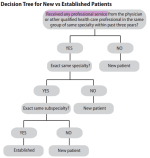
The patient is established per coding guidelines, regardless of how the appointment is scheduled, the forms filled out, or the type of work being performed.
There are many situations where a patient could have an appointment type/scheduled as new, but is not new from a coding perspective. Example:
Patient referred to gynonc for ovarian cyst. Gynonc sees patient first time 01/01/2021 - orders some test, has additional appts. On 06/01/2021 the gynonc says "We're not concerned about this. No change in size. Simple cyst. Get regular gyn care and come back if needed." 2 3/4 years later patient has abnormal PAP and general obgyn refers back to gynonc, schedules for 05/01/2024. The office will often schedule that 05/01/2024 as a new patient for a variety of ADMINISTRATIVE or CLINICAL reasons. The interim history needs to be done. New patient paperwork will be completed. Records relating to this new problem need to be obtained. The length of the appointment may be longer to accomodate these.
Regardless, when it's coded, it is an ESTABLISHED patient. Doesn't matter that it's a new problem. Doesn't matter that the clinician took a thorough history. Doesn't matter that additional forms or paperwork were completed. Doesn't matter that additional records are obtained and reviewed. All these items could potentially contribute to a different level, but it doesn't make the patient new when they were treated by the clinician (or another clinician in the group of the same specialty) in the past 3 years.
The decision tree posted a few days ago by
@CBLENNIE tells you exactly how to code the services.