Wiki To Bill or Not to Bill???

Tara0513

Networker
Messages
67
Location
Colts Neck, NJ
Best answers
0
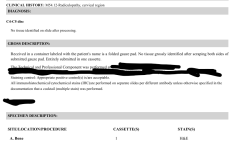
Hello All! The lab I do billing for just brought on a new client and a lot of their specimens that they are sending in are not really specimens, but a container labeled with the patient's name and a folded gauze pad with no tissue identified after scraping both sides of the submitted gauze pad. The lab is still performing an H&E. I copied the report with all personal information both of the patient and lab has been blocked out. Please tell me what I should do as far as coding this report. I did ask my pathology coders Facebook group, and they all stated there is nothing to charge, and why did the lab perform an H&E, but I have the lab pushing back that they should be paid for at least their technical services. I am trying to gather enough supporting information to bring to upper management. They will push back because they believe they should be reimbursed for all work, which I agree with, but I am not sure about these cases.
1754399296828.png1754399336328.png
 
Hi there, unfortunately all work is not payable from a coding or compliance perspective. But the first step is to let the client know they're not collecting the samples correctly. ;) If the lab keeps accepting samples it knows or has good reason to believe will be unusable and then bills for work work related to them, it won't look great from a compliance perspective. I assume the client will send a second sample, which means the patient (and payer) would be billed twice.

Second step is to look at the code they want to bill. They'll be saying they did work on a tissue sample when there's no tissue.
I think this is one to sort out with the payer or even the provider. Perhaps there's some nominal fee for the work of discovering there's no sample, but who knows whether it is worth the work of billing it.
 
This is what I found in the AFP Pathology Service Coding Handbook

No Tissue Received. The concept of medical necessity is a keystone principle that’s applied by all government and private insurers when judging whether a particular medical service is eligible for payment to a physician, hospital, or laboratory. A service is medically necessary if it contributes to the diagnosis, care, or treatment of an individual patient. From a payer or insurer perspective, all professional and facility resources expended in relation to an empty specimen container that’s received by a laboratory must be absorbed by the providers. A medical report should be issued to cover the pathologist and the laboratory for medical and legal purposes, but neither a professional nor a technical charge using 88300 or any other CPT code should be issued by any party to the patient or his/her primary or secondary insurer in relation to this “non-event.”•

Specimen Doesn’t Survive Processing. A very small and/or fragile piece of tissue will be macroscopically examined by the responsible pathologist, but the rigors of the subsequent fixation and embedding process may overcome the viability of the material for microscopic examination. In a situation like this, the pathologist should issue a report setting forth a macroscopic diagnosis for the tissue, with a comment documenting the fact that the material didn’t survive processing for microscopic evaluation. A professional and technical fee under CPT 88300 is reportable for the specimen, but the “regular” microscopic exam code (88302-88309) that would normally have been billed cannot be claimed. For example:− Clinical Example: The gross description for a very small rectal biopsy includes the statement “specimen may not survive processing.” The report confirms that the slide was microscopically examined, but the final diagnosis is “tissue insufficient for diagnosis.”This demonstrates the basis for the coding distinction we must make in a situation like this: a known or reasonably probable negative outcome versus reasonable expectation of a positive outcome. It was known before the rectal tissue was embedded that there was only a 50/50 chance (roughly speaking) that it would support a microscopic diagnosis; hence, code 88300 is reportable for the gross examination, but 88305 for a microscopic examination wouldn’t reflect a medically necessary service. Of course, if the situation were different—if the report didn’t express doubt at the grossing bench as to a viable outcome at the next level of examination—an 88305 charge would be warranted even if the microscopic diagnosis were “scanty mucosal cells present; insufficient for differential diagnosis.”
 
Top
