Get Ready for This Major Prostate Biopsy Code Overhaul
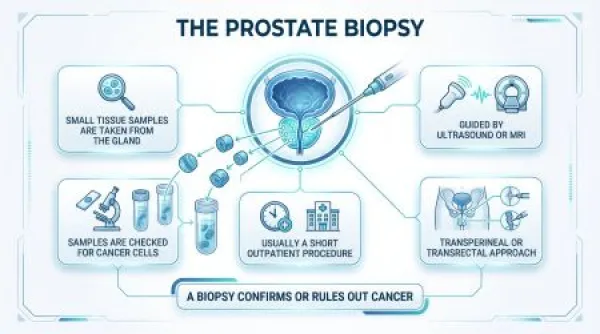
Revisions make imaging guidance, tissue sample numbers, and sample area easier to code. Following its deletion of 55700 (Biopsy, prostate; needle or punch, single or multiple, any approach) at the beginning of 2026, CPT® is continuing its overhaul of the prostate biopsy codes, effective Jan. 1, 2027. Here is a complete rundown of all the code changes to the 55707-+55715 code family you need to know to keep your coding up to date and accurate next year and beyond. Watch for the Removal of Specific Imaging Guidance Language The first major revision to the prostate biopsy codes can be seen in the changed descriptor language to 55707: Notably absent from the revised code, and from several other codes in the group, is language specifying the type of guidance, such as ultrasound (in the case of 55707), CT, MRI, or MRI-ultrasound fusion. Now, coders won’t need to factor imaging guidance into code choice when choosing a code to report prostate biopsies. Be Aware of Change in Sample Size Language Also missing from the descriptor language to the revised 55707 is the word “sextant.” In this kind of biopsy, the provider collects six to 12 tissue cores from the left and right sides of base, middle, and apex of the patient’s prostate. This type of biopsy differs from a saturation biopsy, which is “performed under general anesthesia and … involves 35 to 60 biopsies depending on the size of the prostate,” according to CPTÒ Assistant (November 2010, Volume 20, Issue 11). The deletion of the word also affects the following codes: In other words, the CPT® codes will now no longer describe a procedure that limits the number of tissue samples taken during the biopsy. Instead, codes will now only differentiate between regional (multiple samples taken around the lesion), regional and fusion-targeted (multiple samples taken around the lesion and samples from the targeted lesion itself), and targeted-only biopsies. Note What Hasn’t Changed, and Know What it Means Though CPT® has reorganized the codes into regional and fusion-targeted lesion biopsies, the descriptors still distinguish between approaches, which remain in the codes as transrectal (where the needle passes through the rectum wall and into the prostate) and transperineal (where the needle passes through the region between the anus and genitals and into the prostate). This means the following codes obey this organizational structure: Code Approach Sample area 55707 Transrectal Regional only 55708 Transrectal Regional and targeted 55709 Transperineal Regional only 55710 Transperineal Regional and targeted 55711 Transrectal or transperineal Targeted only This reorganization essentially makes 55712 (Biopsy, prostate, transperineal, MRI-ultrasound-fusion guided, targeted lesion(s) only, first targeted lesion) redundant. Consequently, CPT® has removed it from the 2027 code set. Don’t forget: CPT® 2027 introduces a new targeted lesion add-on code, +55716 (… each additional targeted lesion (List separately in addition to code for primary procedure)). Beware These In-Bore Biopsy Revisions CPT® has also taken the opportunity to revise its coding for in-bore prostate biopsies. In these procedures, the patient lies in the MRI or CT unit while the provider performs the biopsy with a compatible device. This method allows the physician to visualize the lesion, biopsy needle, and needle guide in real time before, during, and after collecting the sample. The 2027 CPT® code book has revised the following codes for in-bore prostate biopsies in keeping with its decision not to specify the type of imaging guidance: Also, in keeping with its decision not to specify the number of tissue samples gathered in the procedure in the code descriptors, CPT® has deleted 55713 (Biopsy, prostate, in-bore CT- or MRI-guided (ie, sextant), with biopsy of additional targeted lesion(s), first targeted lesion), as 55714 has essentially made the code redundant. Strike This Transperineal Saturation Code The same fate awaits 55706 (Biopsies, prostate, needle, transperineal, stereotactic template guided saturation sampling, including imaging guidance). Like the 55714 deletion, this procedure, which is essentially a saturation biopsy that uses a template to map the location of the tissue sample, is also made redundant now that CPT® is no longer classifying prostate biopsy procedures by the number of tissue samples the provider has taken. And Wait for Further Instructions Currently, all the information available about the CPT® code additions, deletions, and revisions for 2027 are the code changes themselves. So, there are no instructions about which codes can, or cannot, be used in conjunction with other codes. Stay tuned to Revenue Cycle Insider for further information about the correct way to use all these revised prostate biopsy codes. Bruce Pegg, BA, MA, CPC, CFPC, Managing Editor, AAPC