Skip Sedation for CT Colonography Procedures
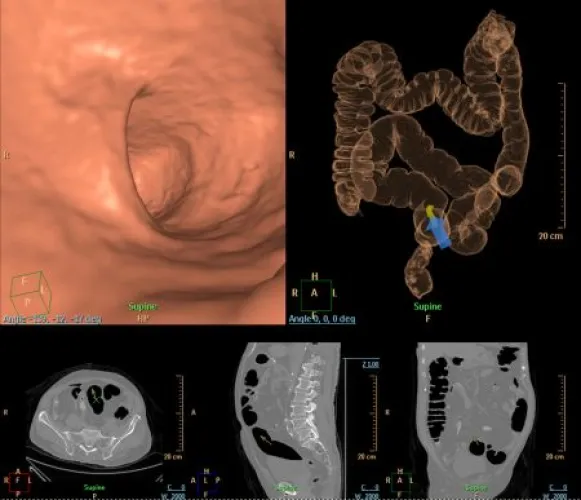
Find out if colonography is acceptable for CRC screenings. During a colonography, a radiologist uses CT technology to visualize the colon and rectum, so they can evaluate the body structures for colorectal cancer, polyps, or masses. The CT colonography (CTC) exam is also known as a virtual colonoscopy and is minimally invasive, which makes it an ideal exam for certain patients. As of 2025, Medicare provides coverage for CTC screenings when the beneficiary meets the eligibility criteria. Read on to learn about screening and diagnostic CTCs and how to correctly code the procedures. Learn How Colonography Differs From a Colonoscopy Physicians may order a CTC for diagnostic reasons, such as when a colonoscopy is incomplete or contraindicated; if there is a suspected obstruction in the intestinal tract; or if the patient is unable to undergo anesthesia due to another condition. In addition to CTC being less invasive and usually not requiring sedation, the procedure differs from a traditional colonoscopy in several other ways, including: CT Colonography Colonoscopy Procedure time Typically, less than 15 min. 45 to 60 min. Capability Diagnostic only Diagnostic + therapeutic Follow-up required Yes, if abnormalities found Usually handled during procedure Providers still consider traditional colonoscopy the gold standard for the exam because the physician can perform a biopsy or remove growths during the same procedure. Meanwhile, CTC is diagnostic at best, so the patient would still need to return for a follow-up colonoscopy if abnormalities are found during the imaging exam. Find the Codes for Colonography Procedures The CPT® code set features three codes for CTC procedures. You’ll assign 74261 (Computed tomographic (CT) colonography, diagnostic, including image postprocessing; without contrast material) or 74262 (… with contrast material(s) including non-contrast images, if performed) for diagnostic CTC exams depending on whether the provider administers contrast material to visualize the body structures. Use 74263 (Computed tomographic (CT) colonography, screening, including image postprocessing) to report a screening colonography procedure. Remember, the patient must be asymptomatic to be eligible for a screening exam. Otherwise, the procedure would fall under a diagnostic CTC procedure. Effective July 1, 2025, Medicare expanded coverage for colorectal cancer screening tests to include CTC. This means that eligible Medicare beneficiaries ages 45 and older can receive a CTC exam for screening purposes. Other eligibility criteria for CTC screenings include: Why Choose Colonography Over Colonoscopy? As mentioned above, CTC exams are less invasive and usually do not require sedation during the procedures. However, providers and patients can have other reasons to opt for the imaging exam over a traditional colonoscopy, including the following: Colonography may be the preferred procedure for certain patients, but they will need to undergo a separate colonoscopy for biopsy or polypectomy if abnormalities are found during the exam. Dive Into the Diagnosis Codes The Centers for Medicare & Medicaid Services (CMS) list several ICD-10-CM codes related to CRC screening tests in national coverage determination (NCD) form 210.3. Examples of diagnosis codes to assign with screening CTC code 74263 include, but are not limited to, the following: If the radiologist performs a CTC for diagnostic reasons, you’ll need to carefully review the radiology report and medical record to ensure you assign the correct ICD-10-CM codes. Patients who present to the radiology practice for a diagnostic CTC may be experiencing any number of signs or symptoms that support the need for the imaging exam. If no abnormalities are found during the exam, you’ll assign the appropriate codes that represent the patient’s symptoms. Examples of symptom codes that you might use include: If the patient undergoes a CTC due to a failed or incomplete colonoscopy, you can assign Z53.8 (Procedure and treatment not carried out for other reasons) or a K56.60- (Unspecified intestinal obstruction) code to indicate that the colonoscopy was not completed. You’ll assign R93.3 (Abnormal findings on diagnostic imaging of other parts of digestive tract) when the radiologist finds abnormalities during a screening or diagnostic CTC. Additionally, you’ll use family and personal history codes to show that the patient’s history puts them at an elevated risk for the exam. These codes and code categories include: Examine These Scenarios Scenario 1: An 87-year-old asymptomatic patient presents for a CRC screening. The provider orders a CTC due to the patient’s advanced age. No symptoms are documented. The exam is completed without contrast, and no abnormalities are found. In this scenario, you’ll assign 74263 to report the CTC screening exam. You’ll then use Z12.11 to indicate that the patient presented for a colon cancer screening. Scenario 2: A patient presents for a diagnostic colonoscopy due to their personal history of adenomatous colon polyps, but the provider is unable to complete the procedure because the patient has a tortuous colon. The provider calls a radiologist and decides to perform a CTC with contrast to evaluate the remaining colon. In this scenario, you’ll report the diagnostic CTC performed by the radiologist with 74262. You’ll also assign Z53.8 to identify the incomplete colonoscopy as the reason for the diagnostic CTC, Z86.0101 (Personal history of adenomatous and serrated colon polyps) to report the patient’s personal history, and Q43.8 (Other specified congenital malformations of intestine) for the tortuous colon. Of course, you’d assign other appropriate diagnosis codes if the radiologist documented any additional findings. Mike Shaughnessy, BA, CPC, Production Editor, AAPC