Wiki E/M with Joint Injections – Orthopaedics Compliance Issue

pclaybaugh

Guru
Messages
115
Location
Titusville, FL
Best answers
0
Looking for feedback from others coding orthopaedics: my group is adding E/Ms to most 20610 joint injections—even when the entire visit focuses on that joint alone.
Per the 2025 NCCI Manual, Ch. IV, p. 4, the eval is included in the procedure. An E/M should only be billed if there’s a separate diagnosis and management unrelated to the injected joint.
Here’s a sample note—they’re calling this a new issue, but I don’t think it justifies an E/M:

Chief Complaint
Left knee pain. X-rays taken today. History of Present Illness
Patient presents today for a new issue. He is here today for his left knee. He reports a traumatic history involving the left lower extremity. He has had multiple surgeries with fixation of his femur and his tibia. He has had an onset of pain in the left knee and felt like he noted some swelling. The pain has improved but is still bothering him. He is here for evaluation of this today.

Physical Exam Vitals & Measurements

ROS: Alert and oriented, well nourished, No acute distress
Lungs: Respiration: Non-Labored
Abdomen: Soft, non-tender, non-distended, Normal bowel sounds, No masses
Musculoskeletal: Left knee: Noted varus alignment. Skin is intact with well-healed scars about the anterior lateral aspect of the distal thigh and proximal tibia. Range of motion 0-15 degrees. Stable varus/valgus stress. Mild tenderness palpation at the medial joint line.
Skin: Skin is warm, dry and pink, No rashes, No lesions
Psychiatric: Cooperative, appropriate mood and affect Procedure Injection left knee

After obtaining informed consent, the left knee is prepped and draped in usual sterile fashion. Through an anterolateral approach the left knee is injected with an admixture of 1 cc of 40 mg Kenalog 2 cc of 1% lidocaine without epinephrine. Patient tolerated the injection well a sterile Band-Aid is applied. Instructed in postinjection care.
Assessment/Plan
Left knee posttraumatic osteoarthritis
He has had terrible trauma to the left lower extremity that was fixed appropriately. Unfortunately appears he has gone on to posttraumatic osteoarthritis. We have discussed this in depth. Further surgical intervention would only be conversion to a total knee arthroplasty. He is not at a point where he is interested in pursuing this. We have also talked about management with corticosteroid injection. He would like to try an injection to the left knee today. We will inject the left knee and I will see him back in 3 months for reevaluation.
Medications and Immunizations This Visit Given Kenalog-40, 40 mg, 2 mL, Intra-articular. For: Osteoarthritis of left knee


Anyone else had to push back on this? Would appreciate your take.

Many thanks!!
 
That is not at all what the NCCI Policy Manual says!

If you want to quote it, it reads, "The decision to perform a minor surgical procedure is included in the payment for the minor surgical procedure and shall not be reported separately as an E&M service. However, a significant and separately identifiable E&M service unrelated to
the decision to perform the minor surgical procedure is separately reportable with modifier 25. The E&M service and minor surgical procedure do not require different diagnoses."

To get the heart of the issue, you need to be clear on what is considered within the E&M component of a minor surgical procedure. Both CPT and CMS defined this fairly similarly to include the decision to perform the procedure itself, explaining risks, benefits, and alternatives, and discussing post procedure care.

It does not, in any way, shape, or form, include the evaluation of a patient's condition, establishing a differential, making their diagnosis, and then determining the potential options and discussing them with the patient. That is a separately reportable E&M service and should be coded separately.

The diagnosis is irrelevant - you don't need a different diagnosis, nor a different body part. NCCI is explicit regarding that. It is helpful to have some documentation of the scope of evaluation to help justify that a separately reportable E&M service has occurred. But the bar to reach a separately reportable E&M should be low. There are some specialties where patients are referred directly for a 010 or 000 global procedure, eg sent to interventional radiology for a guided injection, and this is where there would generally not be a separately reportable E&M - the work up has already been done, the diagnosis established, and the plan established - so no E&M here would be separately reportable. That is not usually the case in ortho.
 
I think the "cross-out test" as explained below is helpful here. https://www.aapc.com/codes/coding-n...2-cJpzl1kMIwjMozCu3zxK8h3KjnK84R7lMsxvl8t8XFR

Tip: "Look at the documentation and cross out anything that is directly related to the procedure performed," says Judith L. Blaszczyk RN, CPC, ACS-PM, compliance auditor with ACE consulting in Leawood, Kan. "Look then at the remaining documentation to determine if it is indeed significant, separately identifiable and medically necessary."
 
That is not at all what the NCCI Policy Manual says!

If you want to quote it, it reads, "The decision to perform a minor surgical procedure is included in the payment for the minor surgical procedure and shall not be reported separately as an E&M service. However, a significant and separately identifiable E&M service unrelated to
the decision to perform the minor surgical procedure is separately reportable with modifier 25. The E&M service and minor surgical procedure do not require different diagnoses."

To get the heart of the issue, you need to be clear on what is considered within the E&M component of a minor surgical procedure. Both CPT and CMS defined this fairly similarly to include the decision to perform the procedure itself, explaining risks, benefits, and alternatives, and discussing post procedure care.

It does not, in any way, shape, or form, include the evaluation of a patient's condition, establishing a differential, making their diagnosis, and then determining the potential options and discussing them with the patient. That is a separately reportable E&M service and should be coded separately.

The diagnosis is irrelevant - you don't need a different diagnosis, nor a different body part. NCCI is explicit regarding that. It is helpful to have some documentation of the scope of evaluation to help justify that a separately reportable E&M service has occurred. But the bar to reach a separately reportable E&M should be low. There are some specialties where patients are referred directly for a 010 or 000 global procedure, eg sent to interventional radiology for a guided injection, and this is where there would generally not be a separately reportable E&M - the work up has already been done, the diagnosis established, and the plan established - so no E&M here would be separately reportable. That is not usually the case in ortho.
Thank you so much for your insight—I really appreciate you taking the time to respond. You were absolutely right about the example I originally shared; after a closer look, it does meet criteria for a separate E/M.
I've since posted a better representation of the kind of documentation I'm more commonly seeing, which is where my concern lies. I'm still relatively new to orthopaedics, so I’m learning the nuance as I go, and feedback like yours is incredibly helpful.
Thanks again—I value the perspective!

Chief Complaint

Recheck OA left knee.
History of Present Illness
Patient presents for follow-up of her left knee.
Physical Exam
Vitals & Measurements
General: Alert and oriented, well nourished, No acute distress
Lungs: Respiration: Non-Labored
Abdomen: Soft, non-tender, non-distended, Normal bowel sounds, No masses
Musculoskeletal: Left knee: Overlying skin intact. She is tender to palpation at the lateral joint line. She does have valgus alignment. Range of motion 5–105-105 degrees, Stable varus valgus at 0 and 30 degrees. Positive mild lateral pseudolaxity.
Skin: Skin is warm, dry and pink, No rashes, No lesions
Psychiatric: Cooperative, appropriate mood and affect
Procedure
injection left knee
After obtaining informed consent, the left knee is prepped and draped in usual sterile fashion. Through an anterolateral approach the left knee is injected with an admixture of 1 cc of 40 mg Kenalog 2 cc of 1% lidocaine without epinephrine. Patient tolerated the injection well a sterile Band-Aid is applied. Instructed in postinjection care.
Assessment/Plan
Osteoarthritis of left knee
Left knee osteoarthritis
I reviewed everything with the patient. She has had excellent relief with corticosteroid injections in the past. She is considering total knee arthroplasty. We have discussed this in depth and I have answered all of her questions. She is considering total knee arthroplasty sometime in the fall, however she would like to repeat an injection today and I agree. So we will give her injection to the left knee and I will see her back in 3 months.
 
The above note documents a fairly clear evaluation, confirms that the patient is not at her treatment goal, suggests that she is indicated for surgery and that a discussion of surgery was performed and the patient elected to defer surgery to a later date. Each element of that is completely separate from the E and M. elements of the Cortizone injection. Given that you have a chronic condition with exacerbation or progression, and a decision to defer a major surgery, this would be a level four office visit in addition to the injection, and would very much be modifier 25 eligible.
 
I agree with Dr. Raizman on all points.

One example of where an E/M *might* not be warranted is if the patient was seen by the MD for knee OA, X-Rays & E/M billed/paid. MD orders and patient agrees to try Visco injections in a series of 3. The patient is scheduled for three of these w/ the PA in the future. The patient returns ONLY for the purpose of the injections. This scenario would not meet the requirements to bill a separate E/M.

If you want to search my username in the forums with the key words modifier 25, 20610, 20611, E/M with injection, major joint injection, etc. There is a lot of info and discussions about it in here. Just check the year of the post to make sure it is not too old.
Examples: https://www.aapc.com/discuss/thread...joint-injection.202507/?view=date#post-554983 https://www.aapc.com/discuss/thread...dure-code-ortho.199599/?view=date#post-547526 https://www.aapc.com/discuss/threads/e-m-with-procedure.199479/#post-547018

What you would also want to do is read and understand the definition of modifier 25. That's what is going to help you decide on separate reporting of an E/M with a minor procedure on the same date. The visit documentation must meet that definition. As stated above, it doesn't matter if there is a different diagnosis or not. I can completely understand why a provider would push back on this if you are telling them they can't code an E/M with those two examples.
 
Agree that the full descriptor for modifier 25 (or any code) is important. From Appendix A of the CPT manual, emphasis added:

It may be necessary to indicate that on the day a procedure or service identified by a CPT code was performed, the patient's condition required a significant, separately identifiable E/M service above and beyond the other service provided or beyond the usual preoperative and postoperative care associated with the procedure that was performed. A significant, separately identifiable E/M service is defined or substantiated by documentation that satisfies the relevant criteria for the respective E/M service to be reported (see Evaluation and Management Services Guidelines for instructions on determining level of E/M service). The E/M service may be prompted by the symptom or condition for which the procedure and/or service was provided. As such, different diagnoses are not required for reporting of the E/M services on the same date. This circumstance may be reported by adding modifier 25 to the appropriate level of E/M service. Note: This modifier is not used to report an E/M service that resulted in a decision to perform surgery. See modifier 57. For significant, separately identifiable non-E/M services, see modifier 59.
 
That is not at all what the NCCI Policy Manual says!

If you want to quote it, it reads, "The decision to perform a minor surgical procedure is included in the payment for the minor surgical procedure and shall not be reported separately as an E&M service. However, a significant and separately identifiable E&M service unrelated to
the decision to perform the minor surgical procedure is separately reportable with modifier 25. The E&M service and minor surgical procedure do not require different diagnoses."

To get the heart of the issue, you need to be clear on what is considered within the E&M component of a minor surgical procedure. Both CPT and CMS defined this fairly similarly to include the decision to perform the procedure itself, explaining risks, benefits, and alternatives, and discussing post procedure care.

It does not, in any way, shape, or form, include the evaluation of a patient's condition, establishing a differential, making their diagnosis, and then determining the potential options and discussing them with the patient. That is a separately reportable E&M service and should be coded separately.

The diagnosis is irrelevant - you don't need a different diagnosis, nor a different body part. NCCI is explicit regarding that. It is helpful to have some documentation of the scope of evaluation to help justify that a separately reportable E&M service has occurred. But the bar to reach a separately reportable E&M should be low. There are some specialties where patients are referred directly for a 010 or 000 global procedure, eg sent to interventional radiology for a guided injection, and this is where there would generally not be a separately reportable E&M - the work up has already been done, the diagnosis established, and the plan established - so no E&M here would be separately reportable. That is not usually the case in ortho.
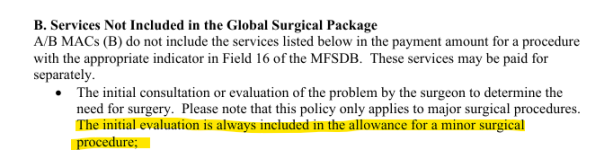
I disagree, the decision to perform a procedure would obviously have to include evaluating and establishing the patient's diagnosis. The decision to perform the minor procedure cannot happen in a vacuum. It requires evaluating the patient's presenting issue, determining a working diagnosis, and then deciding on the appropriate procedure.

1746847024233.png

I certainly do not see a significant or separately billable E/M service based on her example. He briefly discussed surgery, but decided to reevaluate at a later date and instead to perform the injection. That is not significant enough to justify an E/M.

I also strongly disagree that the bar for using modifier 25 should be low. Modifier 25 overuse is a HUGE source of fraud and abuse that the OIG is trying to keep a handle on. The OIG is particularly watching this in dermatology, but I would not be surprised if other areas like wound and ortho come up as well.
 
Last edited:
I disagree, the decision to perform a procedure would obviously have to include evaluating and establishing the patient's diagnosis. The decision to perform the minor procedure cannot happen in a vacuum. It requires evaluating the patient's presenting issue, determining a working diagnosis, and then deciding on the appropriate procedure.

View attachment 7945

I certainly do not see a significant or separately billable E/M service based on her example. He briefly discussed surgery, but decided to reevaluate at a later date and instead to perform the injection. That is not significant enough to justify an E/M.

I also strongly disagree that the bar for using modifier 25 should be low. Modifier 25 overuse is a HUGE source of fraud and abuse that the OIG is trying to keep a handle on. The OIG is particularly watching this in dermatology, but I would not be surprised if other areas like wound and ortho come up as well.
Please cite the source of that snip? Is it here? https://www.cms.gov/Regulations-and-Guidance/Guidance/Manuals/downloads/clm104C12.pdf
Because you must read further down to get the full info on that. There is also an example. It goes on to state, "C. Minor Surgeries and Endoscopies Visits by the same physician on the same day as a minor surgery or endoscopy are included in the payment for the procedure, unless a significant, separately identifiable service is also performed. For example, a visit on the same day could be properly billed in addition to suturing a scalp wound if a full neurological examination is made for a patient with head trauma. Billing for a visit would not be appropriate if the physician only identified the need for sutures and confirmed allergy and immunization status."

And there is additional info further down in the manual as well:
"8. Significant Evaluation and Management on the Day of a Procedure
Modifier “-25” is used to facilitate billing of evaluation and management services on the day of a procedure for which separate payment may be made.

It is used to report a significant, separately identifiable evaluation and management service by same physician on the day of a procedure. The physician may need to indicate that on the day a procedure or service that is identified with a CPT code was performed, the patient’s condition required a significant, separately identifiable evaluation and management service above and beyond the usual preoperative and postoperative care associated with the procedure or service that was performed. This circumstance may be reported by adding the modifier “-25” to the appropriate level of evaluation and management service.

Claims containing evaluation and management codes with modifier “-25” are not subject to prepayment review except in the following situations:

• Effective January 1, 1995, all evaluation and management services provided on the same day as inpatient dialysis are denied without review with the exception of CPT Codes 99221-9223, 99251-99255, and 99238. These codes may be billed with modifier “-25” and reviewed for possible allowance if the evaluation and management service is unrelated to the treatment of ESRD and was not, and could not, have been provided during the dialysis treatment;
• When preoperative critical care codes are being billed within a global surgical period; and
• When A/B MACs (B) have conducted a specific medical review process and determined, after reviewing the data, that an individual or group has high statistics in terms of the use of modifier“-25,” have done a case-by-case review of the records to verify that the use of modifier “-25” was inappropriate, and have educated the individual or group as to the proper use of this modifier. For critical care visits that are unrelated to the surgical procedure but performed on the same day, report modifier -FT as discussed in section 30.6.12.7 of this chapter for further discussion of critical care visits unrelated to the procedure with a global surgical period.

No one stated the bar for using modifier 25 should be low. What I said was, "What you would also want to do is read and understand the definition of modifier 25. That's what is going to help you decide on separate reporting of an E/M with a minor procedure on the same date. The visit documentation must meet that definition."

Is modifier 25 a huge audit target? Yes.
Is modifier 25 overused across the board? Yes.
Do many ortho providers (and others), or their billing/coding/RCM teams slap modifier 25 onto every E/M with every minor procedure regardless of the documentation? Yes.
Are there many times when the separate E/M with modifier 25 in addition to the minor procedure is warranted according to the documentation? Yes.
Should a provider billing/coding correctly never use modifier 25 or never report a documented, justified, and billable E/M with a procedure? No.

OIG work plan item being referred to: https://oig.hhs.gov/reports-and-publications/workplan/summary/wp-summary-0000577.asp
The work plan also indicates the words "generally" and "in general", it is not all or nothing.

"Medicare covers an Evaluation and Management (E/M) service when the service is reasonable and necessary for the diagnosis or treatment of illness or injury, or to improve the functioning of a malformed body member. Generally, Medicare payments for global surgery procedures include payments for necessary preoperative and postoperative services related to surgery when furnished by a surgeon. Medicare global surgery rules define the rules for reporting E/M services with minor surgery and other procedures covered by these rules. In general, E/M services provided on the same day of service as a minor surgical procedure are included in the payment for the procedure. The decision to perform a minor surgical procedure is included in the payment for a minor surgical procedure and must not be reported separately as an E/M service.
An E/M service should be billed only on the same day if a surgeon performs a significant and separately identifiable E/M service that is unrelated to the decision to perform a minor surgical procedure. In this instance, the provider should append a modifier 25 to the appropriate E/M code. In 2019, about 56 percent of dermatologists' claims with an E/M service also included minor surgical procedures (such as lesion removals, destructions, and biopsies) on the same day. This may indicate abuse whereby the provider used modifier 25 to bill Medicare for a significant and separately identifiable E/M service when only a minor surgical procedure and related preoperative and postoperative services are supported by the beneficiary's medical record. We will determine whether dermatologists' claims for E/M services on the same day of service as a minor surgical procedure complied with Medicare requirements."
 
Please cite the source of that snip? Is it here? https://www.cms.gov/Regulations-and-Guidance/Guidance/Manuals/downloads/clm104C12.pdf
Because you must read further down to get the full info on that. There is also an example. It goes on to state, "C. Minor Surgeries and Endoscopies Visits by the same physician on the same day as a minor surgery or endoscopy are included in the payment for the procedure, unless a significant, separately identifiable service is also performed. For example, a visit on the same day could be properly billed in addition to suturing a scalp wound if a full neurological examination is made for a patient with head trauma. Billing for a visit would not be appropriate if the physician only identified the need for sutures and confirmed allergy and immunization status."

And there is additional info further down in the manual as well:
"8. Significant Evaluation and Management on the Day of a Procedure
Modifier “-25” is used to facilitate billing of evaluation and management services on the day of a procedure for which separate payment may be made.

It is used to report a significant, separately identifiable evaluation and management service by same physician on the day of a procedure. The physician may need to indicate that on the day a procedure or service that is identified with a CPT code was performed, the patient’s condition required a significant, separately identifiable evaluation and management service above and beyond the usual preoperative and postoperative care associated with the procedure or service that was performed. This circumstance may be reported by adding the modifier “-25” to the appropriate level of evaluation and management service.

Claims containing evaluation and management codes with modifier “-25” are not subject to prepayment review except in the following situations:

• Effective January 1, 1995, all evaluation and management services provided on the same day as inpatient dialysis are denied without review with the exception of CPT Codes 99221-9223, 99251-99255, and 99238. These codes may be billed with modifier “-25” and reviewed for possible allowance if the evaluation and management service is unrelated to the treatment of ESRD and was not, and could not, have been provided during the dialysis treatment;
• When preoperative critical care codes are being billed within a global surgical period; and
• When A/B MACs (B) have conducted a specific medical review process and determined, after reviewing the data, that an individual or group has high statistics in terms of the use of modifier“-25,” have done a case-by-case review of the records to verify that the use of modifier “-25” was inappropriate, and have educated the individual or group as to the proper use of this modifier. For critical care visits that are unrelated to the surgical procedure but performed on the same day, report modifier -FT as discussed in section 30.6.12.7 of this chapter for further discussion of critical care visits unrelated to the procedure with a global surgical period.

No one stated the bar for using modifier 25 should be low. What I said was, "What you would also want to do is read and understand the definition of modifier 25. That's what is going to help you decide on separate reporting of an E/M with a minor procedure on the same date. The visit documentation must meet that definition."

Is modifier 25 a huge audit target? Yes.
Is modifier 25 overused across the board? Yes.
Do many ortho providers (and others), or their billing/coding/RCM teams slap modifier 25 onto every E/M with every minor procedure regardless of the documentation? Yes.
Are there many times when the separate E/M with modifier 25 in addition to the minor procedure is warranted according to the documentation? Yes.
Should a provider billing/coding correctly never use modifier 25 or never report a documented, justified, and billable E/M with a procedure? No.

OIG work plan item being referred to: https://oig.hhs.gov/reports-and-publications/workplan/summary/wp-summary-0000577.asp
The work plan also indicates the words "generally" and "in general", it is not all or nothing.

"Medicare covers an Evaluation and Management (E/M) service when the service is reasonable and necessary for the diagnosis or treatment of illness or injury, or to improve the functioning of a malformed body member. Generally, Medicare payments for global surgery procedures include payments for necessary preoperative and postoperative services related to surgery when furnished by a surgeon. Medicare global surgery rules define the rules for reporting E/M services with minor surgery and other procedures covered by these rules. In general, E/M services provided on the same day of service as a minor surgical procedure are included in the payment for the procedure. The decision to perform a minor surgical procedure is included in the payment for a minor surgical procedure and must not be reported separately as an E/M service.
An E/M service should be billed only on the same day if a surgeon performs a significant and separately identifiable E/M service that is unrelated to the decision to perform a minor surgical procedure. In this instance, the provider should append a modifier 25 to the appropriate E/M code. In 2019, about 56 percent of dermatologists' claims with an E/M service also included minor surgical procedures (such as lesion removals, destructions, and biopsies) on the same day. This may indicate abuse whereby the provider used modifier 25 to bill Medicare for a significant and separately identifiable E/M service when only a minor surgical procedure and related preoperative and postoperative services are supported by the beneficiary's medical record. We will determine whether dermatologists' claims for E/M services on the same day of service as a minor surgical procedure complied with Medicare requirements."


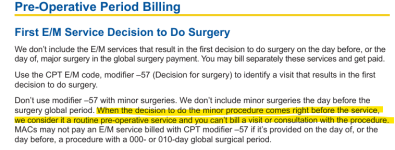
Yes, that’s where I got it. This is also straight from the CMS global surgery manual. https://www.cms.gov/files/document/mln907166-global-surgery-booklet.pdf
1746928348789.png

According to guidance from CPT Assistant (March 2023), certain services typically associated with minor procedures—like reviewing history, assessing the problem area, explaining the diagnosis and procedure, discussing alternatives, obtaining consent, and giving post-op instructions—are considered inherent to the procedure itself and not separately billable as an E/M, unless additional work is clearly documented.

Based on that information, the examples further down in the claims processing manual do not change my opinion about the OP’s example. I completely agree that performing a full neuro exam for a patient with head trauma IS clearly separate from simply suturing a scalp laceration because it involves evaluating for a potentially serious, unrelated condition like intracranial bleeding or concussion.

In contrast, evaluating a knee, discussing treatment options (including surgery), and then ultimately choosing to perform an injection, all for the same presenting problem, is not significant or separately identifiable enough to bill an additional E/M.

My issue was with how NRaizman framed the phrase “the decision for surgery is included in the payment for the procedure,” suggesting it excludes evaluating the presenting problem. That evaluation is integral to the procedure, not distinct from it.

Also, it was that poster who said “the bar to reach a separately reportable E/M should be low,” which I strongly disagree with. Modifier 25 should not be applied lightly, especially given the ongoing scrutiny from the OIG and how frequently it’s misused. I’ve personally encountered wound providers who always bill an E/M with every debridement, we're talking modifier 25 utilization at 100%. It’s not just frustrating, it undermines compliance and risks audits for everyone.

I’m not anti–modifier 25. I just believe it needs to be supported by truly separate and significant service and used responsibly.
 
Last edited:
You are correct, sorry. I meant to state I didn't state the bar should be low.

I agree with you that all of those areas and links state those things. But I think we will have to agree to disagree on the interpretation. I think it depends on the specific procedure being reported and the, "usual preoperative and postoperative services", "Pre- and post-operative services typically associated with a procedure."

I agree with you that Modifier 25 should not be applied lightly. However, it should be used when appropriate and documented.

In the context of the orthopedic office visit example, I think it also depends on the documentation and the patient. In the example above, if this was an established patient who has been coming in routinely 3x/year for a couple years for end-stage RT knee OA, they are not ready for surgery but it has already been discussed in prior visits, there is no medication other than the normal OTC Tylenol they have had for years, there are no changes, no other complaints, health history and everything else is the same, they get a routine injection every time, it may not warrant a separate E/M. It's the hello, welcome back, here for your injection, 10 minute in and out type visit. If that same patient came in for the same thing, but let's say they have had a significant weight change, now have been diagnosed w/ diabetes by the PCP, they ask about doing PT/aquatic therapy, there are new X-Rays, etc. that would possibly warrant an E/M w/ injection.

Specifically, the OP's first example definitely supports an E/M w/ 25 and the injection/drug.
The second one, is a toss-up, I think it depends on what the other office visits show for that patient and, if this was the 1st discussion of TKA, it might warrant an E/M. If this is a routine f/u injection and they had already talked about the TKA prior, maybe not.
 
Thanks to everyone for the spirited and insightful feedback. I knew this was a bit of a hot topic, and I appreciate all the perspectives shared.
For what it’s worth, I did do my research before posting and fully recognize that billing an E/M alongside a joint injection has been heavily scrutinized. My first example may not have been ideal (I’ll own that), but I still feel the second example doesn’t meet criteria for a separately reportable E/M.
Since posting, I’ve gone back and looked at previous encounters from the same provider. What I’m seeing is the same conversation—pain, possible surgery, treatment plans—repeated in multiple notes. Given that, I don’t believe an additional evaluation is warranted each time.
There is also no a proliferation nutritional counseling (99401) and smoking cessation codes. The justification for 99401 is time spent discussing weight loss and surgical candidacy. Again, I feel this should be considered part of the ongoing evaluation that began when surgery was first discussed—not a distinct preventive service.
Appreciate the conversation and everyone's expertise—this is exactly why I ask. :)
 
I understand your perspective. The CPT-A article, though, is about billing AFTER the decision for surgery has been made, and that is a completely separate issue and should not be conflated here.

If I see a new patient with an acute traumatic injury or chronic shoulder pain, I am not evaluating them for suitability for an injection. I am starting from scratch, eliciting a history, reviewing and performing studies, performing a comprehensive orthopaedic exam to arrive at a putative diagnosis. That diagnosis likely has multiple treatment options, which I have to evaluate, present and discuss with the patient. That is a true and undieniably separate E&M service. If we decide to do an injection, THEN, I would perform the E&M associated with that minor procedure - reviewing risks, benefits and alternatives, discussing expected outcomes, confirming patient suitability for the procedure, etc.

If I did a trigger finger injection, and the patient comes back three months later for another one, then I don't charge an E&M.

But for most of my encounters, the idea that the evaluation I performed is inclusive to an injection is absolutely and utterly insulting to me as an orthopaedic surgeon.
This perspective is shared by essentially every physician in the country and is advocated by every professional society in medicine.

CMS attempted to argue that there was enough overlap in the work between E&M and injections that they proposed not to pay an E&M on the same day. That made it into the PFS Proposed Rule in 2018 and received so much vociferous objection, on the part of both patient advocates and physician groups, that they backed off and that proposal has NEVER been finalized into the PFS. Some private payors attempted to weaponize CMS' opinion from that proposed rule, and those payors have been only moderately successful in doing so, often being taken to the state insurance board by the state medical societies and being forced to withdraw their policies. It is a battle being fought on a daily basis, and, as coders, you need to be mindful of whether your obligation is to take the tack of the insurers and be overly conservative to avoid scrutiny, or to support your practitioners when billing appropriately. If you can educate your providers on how to appropriately document visits so that it is very clear when and if a separate E&M service is being performed, then that is maybe the best thing you can do.

As the chair of coding compliance for a 170-surgeon orthopaedic group, my job is not to avoid audits or run scared from OIG scrutiny. The definition of what constitutes the E&M associated with a procedure is clearly defined by CPT. If your practitioners are clearly defining a separate and identifiable service that is beyond merely assessing the suitability of a patient for a minor procedure, reviewing risks/benefits/alternatives, and discussing post-procedure care, and clearly documenting it, you should generally defer to them. It is the ultimate responsibility of the physician to assess whether the service is separate and identifiable, and if they get a denial or pushback, then it is their prerogative as to whether it is appropriate to appeal. But the ultimate responsibility is theirs, as is the liability.

In the case of the original example, I would absolutely support a separate E&M and a -25, and I would absolutely go to the mat defending that. But I also provide education to our doctors and PA's to ensure that their documentation is appropriate, that they are not embellishing, and that they understand when -not- to use a -25 modifier.

Cheers!
Noah


Yes, that’s where I got it. This is also straight from the CMS global surgery manual. https://www.cms.gov/files/document/mln907166-global-surgery-booklet.pdf
View attachment 7946

and From CPT Assistant March 2023:

"Requires awareness of usual preoperative and postoperative services. When an E/M service is reported in conjunction with another procedure, the E/M service should include work performed above and beyond the usual preoperative and postoperative services associated with the procedure performed on the same date of service. Physicians and other QHPs should be aware of what services are included in a surgical package, as those would not be reported separately.


As listed and defined in the surgical package definition in the Surgery guidelines of the CPT code set, some of the specific services included in a given CPT surgical code include E/M service(s) subsequent to the decision for surgery on the day before and/or day of surgery (including patient history and physical examination) and immediate postoperative care, including dictating operative notes, talking with the family and other physicians or other QHPs, writing orders, evaluating the patient in the postanesthesia recovery area, and typical postoperative follow-up care.

Pre- and post-operative services typically associated with a procedure include the following and cannot be reported with a separate E/M services code:

Review of patient's relevant past medical history,

Assessment of the problem area to be treated by surgical or other service,

Formulation and explanation of the clinical diagnosis,

Review and explanation of the procedure to the patient, family, or caregiver,

Discussion of alternative treatments or diagnostic options,

Obtaining informed consent,

Providing postoperative care instructions,


Discussion of any further treatment and follow up after the procedure."

Based on that information, the examples further down in the claims processing manual do not change my opinion about the OP’s example. I completely agree that performing a full neuro exam for a patient with head trauma IS clearly separate from simply suturing a scalp laceration because it involves evaluating for a potentially serious, unrelated condition like intracranial bleeding or concussion.

In contrast, evaluating a knee, discussing treatment options (including surgery), and then ultimately choosing to perform an injection, all for the same presenting problem, is not significant or separately identifiable enough to bill an additional E/M.

My issue was with how NRaizman framed the phrase “the decision for surgery is included in the payment for the procedure,” suggesting it excludes evaluating the presenting problem. That evaluation is integral to the procedure, not distinct from it.

Also, it was that poster who said “the bar to reach a separately reportable E/M should be low,” which I strongly disagree with. Modifier 25 should not be applied lightly, especially given the ongoing scrutiny from the OIG and how frequently it’s misused. I’ve personally encountered wound providers who always bill an E/M with every debridement, we're talking modifier 25 utilization at 100%. It’s not just frustrating, it undermines compliance and risks audits for everyone.

I’m not anti–modifier 25. I just believe it needs to be supported by truly separate and significant service and used responsibly.
 
I understand your perspective. The CPT-A article, though, is about billing AFTER the decision for surgery has been made, and that is a completely separate issue and should not be conflated here.

If I see a new patient with an acute traumatic injury or chronic shoulder pain, I am not evaluating them for suitability for an injection. I am starting from scratch, eliciting a history, reviewing and performing studies, performing a comprehensive orthopaedic exam to arrive at a putative diagnosis. That diagnosis likely has multiple treatment options, which I have to evaluate, present and discuss with the patient. That is a true and undieniably separate E&M service. If we decide to do an injection, THEN, I would perform the E&M associated with that minor procedure - reviewing risks, benefits and alternatives, discussing expected outcomes, confirming patient suitability for the procedure, etc.

If I did a trigger finger injection, and the patient comes back three months later for another one, then I don't charge an E&M.

But for most of my encounters, the idea that the evaluation I performed is inclusive to an injection is absolutely and utterly insulting to me as an orthopaedic surgeon.
This perspective is shared by essentially every physician in the country and is advocated by every professional society in medicine.

CMS attempted to argue that there was enough overlap in the work between E&M and injections that they proposed not to pay an E&M on the same day. That made it into the PFS Proposed Rule in 2018 and received so much vociferous objection, on the part of both patient advocates and physician groups, that they backed off and that proposal has NEVER been finalized into the PFS. Some private payors attempted to weaponize CMS' opinion from that proposed rule, and those payors have been only moderately successful in doing so, often being taken to the state insurance board by the state medical societies and being forced to withdraw their policies. It is a battle being fought on a daily basis, and, as coders, you need to be mindful of whether your obligation is to take the tack of the insurers and be overly conservative to avoid scrutiny, or to support your practitioners when billing appropriately. If you can educate your providers on how to appropriately document visits so that it is very clear when and if a separate E&M service is being performed, then that is maybe the best thing you can do.

As the chair of coding compliance for a 170-surgeon orthopaedic group, my job is not to avoid audits or run scared from OIG scrutiny. The definition of what constitutes the E&M associated with a procedure is clearly defined by CPT. If your practitioners are clearly defining a separate and identifiable service that is beyond merely assessing the suitability of a patient for a minor procedure, reviewing risks/benefits/alternatives, and discussing post-procedure care, and clearly documenting it, you should generally defer to them. It is the ultimate responsibility of the physician to assess whether the service is separate and identifiable, and if they get a denial or pushback, then it is their prerogative as to whether it is appropriate to appeal. But the ultimate responsibility is theirs, as is the liability.

In the case of the original example, I would absolutely support a separate E&M and a -25, and I would absolutely go to the mat defending that. But I also provide education to our doctors and PA's to ensure that their documentation is appropriate, that they are not embellishing, and that they understand when -not- to use a -25 modifier.

Cheers!
Noah

I appreciate your response, but I'm still not 100% sure I agree. This is because CMS even states that a patient being "new" isn't enough to justify billing an E/M with a minor procedure, and wouldn't a new patient require the full assessment including exam, treatment options, etc. before a decision for a procedure?

It's not even that I necessarily agree with CMS/AMA about how strict their modifier 25 conditions are, and I can definitely understand how it would feel insulting that the assumption is that a full evaluation is covered in the payment for an injection. I know physicians/QHPs bear the brunt of the responsibility when things go south, but coders have also gotten in trouble too, so I do get a bit worried sometimes especially if a provider's utilization is much higher than average. I do try to be as compliant as possible, but I also err on the side of the provider(s).

The attack on modifier 25 runs deep, and now with increased use of AI auto-denying almost any claim with modifier 25 attached despite it being clearly supported, it's definitely a constant battle.
 
We are not having any issues at all with our payors, whether it is CMS or commercial, appropriately reimbursing our E&M's alongside injections with a -25 modifier.
It all comes down to good and consistent documentation, and we work with our EMR (ModMed, no COI) to have that documentation clear and concise in a way that both our coders and 3rd party AI will not kick it out. It has taken a bit of work, but we are rarely getting denials. Also, we are, across the board, hitting a nearly 90% accuracy rate across all providers with our AAPC-outsourced external audits, which we perform each year, and most of the discrepancies there are ICD-10, level-setting, and incident-to, not Modifier 25.

There is probably some regional variation here, but I would just note that, if you do this well, you should hopefully not get denials.

Would still emphasize that ultimate legal responsibility lies with the physician. As a surgeon, I have my scribes document what I do, and the work that goes into it. That work is an E&M service. It is really that simple. But if you need more evidence as to what exactly is included in the injection service, look to what was actually published by both CMS and CPT - the clinical vignettes.

If you review the Clinical Vignette for 20610 that is used by AMA/CPT, was reviewed by the RUC to establish reimbursement, and certified by CMS subsequently, the ENTIRE pre-service work, ie everything other than the injection itself, consists of this: "Explain procedure to patient and/or family. Discuss possible complications and obtain informed consent. Verify that all required instruments and supplies are available. Position patient appropriately for injection access to the joint. Mark and confirm injection site, and prepare site. "

That is IT. Nothing else.
Despite further attempts by CMS to argue that the work is overlapping, which were soundly rejected, the CMS-accepted description of work does not include any evaluation service. This is as canonical as it gets, really.
 
We are not having any issues at all with our payors, whether it is CMS or commercial, appropriately reimbursing our E&M's alongside injections with a -25 modifier.
It all comes down to good and consistent documentation, and we work with our EMR (ModMed, no COI) to have that documentation clear and concise in a way that both our coders and 3rd party AI will not kick it out. It has taken a bit of work, but we are rarely getting denials. Also, we are, across the board, hitting a nearly 90% accuracy rate across all providers with our AAPC-outsourced external audits, which we perform each year, and most of the discrepancies there are ICD-10, level-setting, and incident-to, not Modifier 25.

There is probably some regional variation here, but I would just note that, if you do this well, you should hopefully not get denials.

Would still emphasize that ultimate legal responsibility lies with the physician. As a surgeon, I have my scribes document what I do, and the work that goes into it. That work is an E&M service. It is really that simple. But if you need more evidence as to what exactly is included in the injection service, look to what was actually published by both CMS and CPT - the clinical vignettes.

If you review the Clinical Vignette for 20610 that is used by AMA/CPT, was reviewed by the RUC to establish reimbursement, and certified by CMS subsequently, the ENTIRE pre-service work, ie everything other than the injection itself, consists of this: "Explain procedure to patient and/or family. Discuss possible complications and obtain informed consent. Verify that all required instruments and supplies are available. Position patient appropriately for injection access to the joint. Mark and confirm injection site, and prepare site. "

That is IT. Nothing else.
Despite further attempts by CMS to argue that the work is overlapping, which were soundly rejected, the CMS-accepted description of work does not include any evaluation service. This is as canonical as it gets, really.
Thanks, Noah! I appreciate your detailed follow-up. I completely agree that clear, consistent documentation is what ultimately justifies modifier 25, and it’s great to hear your group has built such a strong infrastructure around that. I wish even a small majority of healthcare systems took documentation integrity as seriously.

Regarding the CPT vignette for 20610. My understanding is that those vignettes are used during the RUC valuation process to define procedural work and help establish RVUs. So yes, the pre-service work described is limited to procedural prep and consent. But from what I’ve read, those vignettes don’t override the general CMS rule that when the decision to perform a minor procedure is made at the same visit, that decision is considered part of the procedure, unless additional work beyond that scope is clearly documented per the CMS global package definition.

1747980405511-png.7982


I think our main difference was less about the possibility of billing E/M with a procedure, I agree it can absolutely be appropriate, and more about how often that bar is truly met in typical outpatient settings, especially when documentation is sparse or templated. Not every group has the kind of internal audits, EMR optimization, and provider education that yours clearly does.
 
Last edited:
I think it is important to remember that CMS is just a single payor, whereas the definitions for CPT codes are established by AMA/CPT (with direct input from CMS) and accepted by all payors. Individual payment policies vary substantially, and when there is a seeming conflict between CMS policy and CPT, a coder may need to individuate by payor.

This is true, for example, in the application of the -59 modifier (many procedures with an NCCI PTP edit of "1" are easily and often justified and paid for with private payors using a -59, whereas CMS will only pay a -59 modifier if that surgery is done on the contralateral side).

The definition of what evaluative work is inclusive to joint injection was clearly specified by CPT, published by CPT, and accepted by CMS when they accepted the RUC valuation. CMS' subsequent attempts to redefine that work were unsuccessful and were roundly criticized. The definition remains the same, despite the bean counters in Baltimore trying to save money by inappropriately paying doctors less for the work they do.

Our job as coders is one of translation - we take clinical notes and data and translate them into a system of codes and bills that is essentially a foreign language. We should strive to do it with fidelity. I get emails from surgeons across the country whose hospital-based, system-based or even practice-based coders are working against them, even when the documentation is clear. They should be fighting for appropriate reimbursement, not setting up roadblocks.
N
 
Top