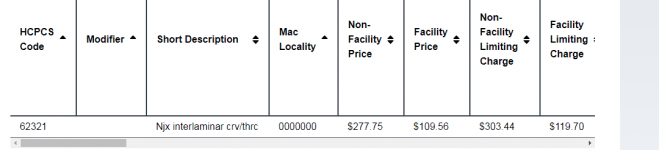
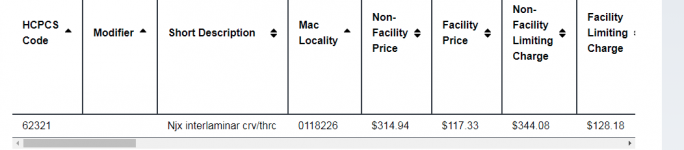
The Medicare fee schedule is based on the RBRVS (Resource-Based Relative Value Scale). Every CPT code has a RVU (relative value unit) that is a measure of how much work goes into it (in the simplest sense), with a geographic component (GPCI) thrown in.
The formula for the Medicare fee schedule is:
[(Work RVUs x Work GPCI) plus
(Non-Facility Practice Expense RVUs x PE GPCI) plus
(Professional Liability Expense RVUs x PL GPCI)] x
Conversion Factor (CF)
For 2020, in my town GPCIs were: Work was 1.024, Practice Exp was 1.070, and Prof Liab was 0.580.
For sake of example, let's use 99215. The Work RVU for that code is 2.11; the PE is 1.85, and the PLI is 0.15
(2.11 x 1.024) plus (1.070 x 1.85) plus (0.580 x 0.15) = (2.161) plus (1.980) plus (0.087) = 4.228
So in my town, 99215 is worth 4.228 RVUs. Compare that to a surgery which may have RVUs in the double digits. The last component is the conversion factor. The Medicare conversion factor for 2020 was $36.09. So 4.228 times 36.09 = $152.59, which is what we got paid for a 99215 from Medicare. The beauty in this is that you don't have to refigure your fee schedule every year, all you do is change the conversion factor (to adjust for inflation, for instance), and your software (if it's set up properly) will adjust your fee schedule for you. Medicare doesn't go through every CPT code every year and manually change the dollar amounts; they simply adjust the conversion factor.
Apparently AppleCare has a different Conversion Factor than Medicare does.
This page (click me) gives you a brochure to help you understand, plus a link to a RBRVS Conversion Spreadsheet.