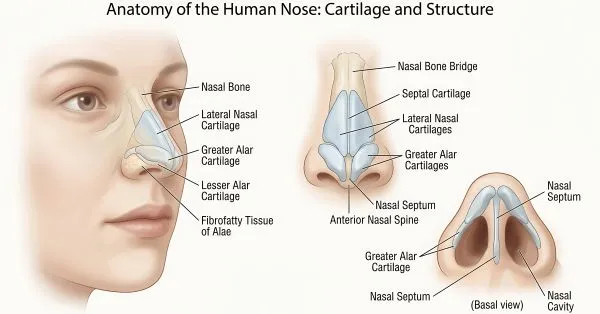
Understand Nasal Anatomy to Correctly Code This Closed Treatment Encounter
Question: The operative report states: “Asch forceps were used to medialize the septum from the right over to the midline position and butter knife was used to carefully elevate the depressed segment on the right side, and manual manipulation was used to move the nasal dorsum from the left over to the midline position.” In this encounter, can I bill 21337 with 21320, using modifier 59 on 21320? My physician says 21320 should be paid separately as it is truly a separate procedure, but I am not sure that the documentation I have been given supports this. AAPC Forum Participant Answer: The simple answer to your question is, yes, it is possible to bill 21320 (Closed treatment of nasal bone fracture; with stabilization) and 21337 (Closed treatment of nasal septal fracture, with or without stabilization) together with the appropriate modifier. That’s because the two codes describe closed treatments of two different nasal structures: the nasal septum, which “divides the nasal airway and is located posterior and inferior to the nasal bones,” per CPT® Assistant, Volume 29, Issue 9 (September 2019). Your documentation states clearly that the provider performed closed treatment of the septum (21337) and the nasal bone, or dorsum (21320). Additionally, your provider’s use of a “butter knife,” a nickname for a Boies elevator, indicates that they performed stabilization on the nasal bone. You are also correct in saying that you will need to append modifier 59 (Distinct procedural service) or XS (Separate structure) to 21320, depending on payer preference, to show that the two procedures are separate and distinct. Payers that follow National Correct Coding Initiative (NCCI) edits regard the two procedures as bundled, but when 21337 is the column 1 code, a modifier indicator of “1” on the bundle means you can bill the two procedures separately with an appropriate NCCI-associated modifier. Bruce Pegg, BA, MA, CPC, CFPC, Managing Editor, AAPC