

Online medical coding training
Begin a rewarding career in healthcare as a certified medical coder.Why start a career in medical coding?
Medical coders play a quiet but essential role in healthcare. They take the details from patient visits — what care was provided and why — and turn that information into standardized codes that help keep everything accurate and organized behind the scenes.
✓ Train from home
✓ Earn an industry-leading certification (CPC®)
✓ Open the door to remote job opportunities
✓ Join a growing field with strong demand

How to become a medical coder: Step by step
Enroll in medical coding training.
Train online for 16 weeks, or at your own pace. No experience required.Become a Certified Professional Coder (CPC).
Pass your medical coding exam with a score of 70% or higher.Land your first role.
Lean into AAPC career resources to gain experience and access to over 200,000 professionals in the industry.
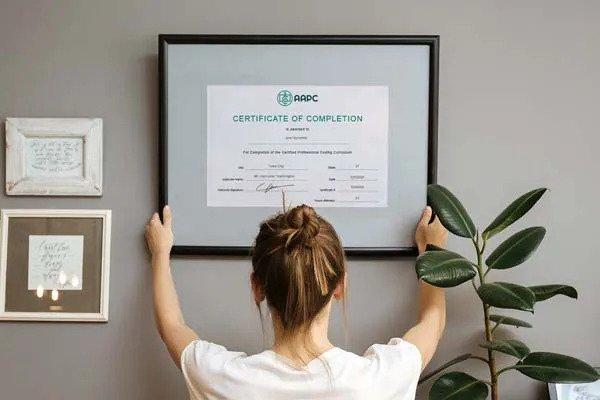
Earn the most respected medical coding certification in the healthcare industry.
Learn to analyze medical records and assign accurate codes that support billing, insurance claims, and compliance, while also building practical coding experience to help you confidently launch your career.
Most medical coders start with the CPC because of the world of career growth and job opportunities it opens up. With the CPC, you can continually expand your skills and move into higher roles in the healthcare field.
Flexible course formats for different needs.
Self-paced training
100% online
Self-paced training puts you in control of the schedule. You move through the material on your own time, at your own speed — a good fit if you're balancing training around a job, family, or other commitments and want the flexibility to learn whenever it works for you.
Instructor-led training
100% online
Instructor-led training adds structure and support. You'll work through the material alongside an instructor, with real-world examples and guided instruction to help concepts click faster — a good fit if you learn best with expert guidance and a set schedule to keep you on track.
What you'll learn in your medical coding course
Develop the ability to interpret medical records
Acquire a fundamental knowledge of medical terminology and anatomy
Comprehend and utilize the ICD-10-CM, CPT®, and HCPCS Level II code books
Implement coding conventions when assigning diagnosis and procedure codes
Learn to accurately determine the level of Evaluation and Management (E/M) services
Practice coding various patient services using CPT®, ICD-10-CM, and HCPCS Level II codes
Evaluate and code operative reports and evaluation and management services

Everything you need to get started. All included.
Your tuition covers more than just training. It includes the exams, software tools and support to help you build your skills, earn your certification and take the next step toward your new career.
Certification exams
Your chance to turn what you've learned into a credential employers recognize.
Train with the organization that creates the certification exams. You'll know what to expect and have the preparation you need to feel confident on exam day.
AAPC membership
You're not just starting a course. You're joining a community. Get access to career resources, expert advice, continuing education, and a network of professionals and hiring managers who can support you throughout your career.
Real-world coding practice
Build experience before you land your first coding job. Practice coding real-world medical cases with Practicode. Build your confidence, strengthen your skills, and work toward removing the apprentice designation from your CPC credential.
Practice exams
Walk into exam day knowing what to expect. Get comfortable with the exam format, questions, and online testing experience. Practice as many times as you need until you achieve a passing score.
Code books
All the required code books needed to complete your course and exam will be included: AMA CPT® Professional Edition, HCPCS Level II Expert Code Book, ICD-10-CM Expert, Medical Coding Training: CPC (eBook), Medical Billing Training: CPB (eBook).
Code look-up tool
Find the right codes faster and with greater confidence. Learn how to use a convenient tool that helps you look up medical codes, improve accuracy, and work more efficiently.
Salary
How much do medical coders make?
Medical records specialists earn $67,147 a year on average, according to AAPC’s 2026 Medical Coding and Billing Salary Report.
The report identifies certification as the strongest factor influencing pay. Survey respondents with three or more AAPC certifications earned an average of $81,227 a year.
Increase your job opportunities and earning potential with experience and additional certifications for specialty coding or other advanced roles.

Where can the CPC take you?
190+ job titles
in CPC job postings
Employers listed more than 190 distinct job titles in postings seeking CPC-certified professionals. More than half of job postings seeking a CPC were for roles beyond “medical coder.”
Rising demand for CPCs
+8% CPC postings
Job postings seeking CPC-certified professionals rose 8%, even as U.S. job postings overall held steady.
20.7% higher pay
with 1 certification
Medical billers and coders with just one AAPC certification make 20.7% more than those who aren’t certified. Our education pays for itself in the first year.
Roles CPCs are getting hired for
Medical coder
Certified coding specialist
Medical biller
Billing specialist
Medical records technician
Insurance verification specialist
Patient registration
Front desk
Unit secretary
Financial counselor
Top medical coding skills needed
Attention to detail
Knowledge of medical terminology
Understanding of anatomy and physiology
Analytical thinking
Familiarity with coding systems (ICD, CPT®, HCPCS)
Problem solving
Computer and electronic health record (EHR) proficiency
Ability to work independently
Medical record interpretation
Clear communication with providers
Hiring roles: AAPC member data. Job postings: U.S. job postings, July 2022–July 2026; source: Lightcast.
AAPC's 2026 Medical Coding and Billing Salary Report
Learn more about the industry
Get a feel for what medical coders do and how their work fits into healthcare through our free introductory medical coding lessons.
FAQ
Medical coding is the process of translating information in a patient’s medical record into standardized codes. For example, after an office visit, a medical coder reviews the provider’s notes and selects codes that describe the patient’s diagnosis and the services they received. The billing team uses those codes to prepare an insurance claim.